


A Lenten Journey of Obedience
Week 1 – Entering Lent
February 18 - 21 | Wednesday - Saturday
DO NOT EDIT
Your content goes here. Edit or remove this text inline or in the module Content settings. You can also style every aspect of this content in the module Design settings and even apply custom CSS to this text in the module Advanced settings.
February 18, Wednesday | Lent — Called to Obedience by Grace - Maisa Oliveira
“And he said to all, ‘If anyone would come after me, let him deny himself and take up his cross daily and follow me.’” (Luke 9:23)
Lent is a meaningful season for reflection and preparation for Easter. It is not a requirement or a way to gain God’s favor. Instead, it is an intentional period to recall Christ’s call and to renew our commitment to Him. We are called only by God’s grace. This calling naturally leads us to obedience, not as a condition for salvation, but as a consequence of it. Just as Jesus taught, denying ourselves and taking up the cross is not just an action for forty days, but a daily attitude that influences our entire life.
This Lenten season also offers an excellent opportunity for reflection as a break amid our busy lives. Our culture tends to be emotionally driven, encouraging us to pursue quick pleasures, which can lead to a more superficial faith. In such an environment, practicing obedience involves gently resisting the temptation of the “shortcut,” personal rewards, and shallow religiosity. This gentle resistance helps us cultivate a deeper and more genuine spiritual journey.
“Has the LORD as great delight in burnt offerings and sacrifices, as in obeying the voice of the LORD? Behold, to obey is better than sacrifice, and to listen than the fat of rams.” (1 Samuel 15:22)
Lent is choosing to live before God with honesty, even when it goes against what everyone else does. During Lent, practices like fasting, prayer, and Bible reading can be rediscovered in the light of grace. They are not sacrifices to compensate for sins but disciplines that help us remember who we are in Christ. By surrendering sinful desires, we are prompted to examine our hearts and recognize everything related to the central role of Christ in our lives. Thus, Lent is a constant invitation to repentance, to renewal of the calling, and to joyful obedience. We do not walk toward Easter trusting in our practices, but in Christ’s completed work, which calls us to follow Him with faith, gratitude, and fidelity each day.
Prayer: Lord, we are grateful because Your love has reached us and called us through Your grace. During this Lenten season, help us learn to live in obedience and sincerely surrender to Your sovereign will. May our lives reflect the essence of Christ in our homes and in our community. In the gracious and precious name of Jesus, Amen.
ABOUT THE AUTHOR – Maisa Oliveira

Lay Pastor andWorship Leader of New Life Brazilian Church, Plano TX. Married with Toninho Oliveira. I am a someone who really loves music, good food, and to always be around people.
February 19, Thursday | Lent — A Posture of Surrender - Josh Avila
“Then Mary said, ‘Here am I, the servant of the Lord; let it be with me according to your word.’ Then the angel departed from her” (Luke 1:38, NRSV).
This memorable interaction between Mary and the angel (Luke 1:26–38) is usually associated with the Advent season rather than Lent, yet in that moment Mary embodied the very essence of Lent in her response to God’s call—faithful surrender. The call of God, like many biblical themes, carries layers of meaning that range from conversion to consecration to commission; sometimes, as in the case of Paul, it holds all three at once. God’s call also comes in many forms. For some, it is impressed upon them through providential circumstances that leave little room for preference, as with Jonah. Others experience something more like Mary’s encounter—a vision, a dream, or an unexpected spiritual event that overwhelms them, as with Isaiah. For still others, it is a quiet yet persistent longing for Jesus and his kingdom, as with Nicodemus.
Whatever form it takes, our response is meant to assume the same posture: one of humble embrace. God-glorifying reflection, repentance, and renewal are not possible without vulnerable receptivity to God’s revelation; obedience requires openness. Where do you sense the Lord’s call today? Is it to fan the flame of faith, to deepen dependence, or to surrender sacrificially? As we ponder Jesus’ road to the cross, let us take a moment to quietly receive—or release—whatever God asks, emulating Mary’s posture of surrender to the gospel’s many calls: “Here am I, the servant of the Lord; let it be with me according to your word” (Luke 1:38, NRSV).
A Prayer of Surrender
Lord, today I come with unresolved emotions—anxiety, pain, loss, shame, whatever feelings accompany my obvious unworthiness. Still, “my soul clings to you, because your right hand upholds me” (Psalm 63:8). Through the tenderness of your Son, I hear you calling to me, and by your comforting Spirit I am drawn toward practicing humble embrace. Here am I, Lord. Let it be with me according to your word. In the name of the Father, the Son, and the Holy Spirit. Amen.
ABOUT THE AUTHOR – Josh Avila

Hello! My name is Josh Avila and I am a rowdy Cuban-American that met the radical love of God in the gospel of grace. My journey of faith has included marrying my beautiful and delightful best friend, Daniela, and having two rambunctious daughters, whose silliness reminds me that Jesus is fun. I’ve also had the privilege of attending, and graduating, the Flourish Institute of Theology along with receiving my first call as an ECO pastor. For better or worse, I currently enjoy serving as the Assistant Pastor at Indian River Presbyterian Church. Pray for them!
February 20, Friday | Knowing When We Are Called - Chris DiVietro
Pray: Liturgy for the Ritual of Morning Coffee, by Doug McKelvey
Read: Psalm 126
Israel was a people who—at times—knew when they were. As Psalm 126 opens, Israel is in a present season of hardship but looks backward on an occasion of God’s deliverance. In so doing, Israel is buoyed as they anticipate God’s future and forthcoming deliverance. This is a familiar rhythm in the Psalms: Israel looks back on God’s past deliverance for present confidence in God’s future provision.
Knowing when we are matters, because calling is often less about where (Where am I called from? Where am I called to?) or what (What am I called to do?) and more about when: When am I?
Parker Palmer invites us to listen to ourselves, to hear how God has already been at work. Calling, then, can be considered a synthesis—a culmination of all that God has done in past seasons to prepare us for future seasons. In this way, calling seems to flow from our relationship with our past, our present, and our future, and listening to ourselves means grappling with when we are.
What is your relationship with your past? How do you discern the movement of God in your past – in your hurts and wounds? How have you noticed, with Joseph, that what some meant for evil God actually meant for good? Søren Kierkegaard says that life is understood backward but can only be lived forward. When you look back, what do you notice? Where can you, with the gift of hindsight, see God moving?
What is your relationship with your present? How present are you to King Jesus, to yourself, to those around you? John Calvin says that knowledge of God and knowledge of self are inextricably intertwined. How much attention do you give to Jesus, who is always attentive to you? How purposefully and willingly are you with God, who is always already with you?
What is your relationship with your future? What, or who, inspires your confidence for the future? We read in 1 John 5:4–5 that our faith in Jesus is our means of victory; our future is guaranteed by another. When you think about your future, who or what fills you with hopefulness?
Psalm 126 closes with the honest and frustrating recognition that tomorrow’s joy is often made possible by today’s tears. Israel knows this because, at times, they knew when they were. How is God calling you? Well, when are you?
ABOUT THE AUTHOR – Chris DiVietro

Chris was the Pastor/Head of Staff of Park Road Presbyterian Church between 2017 and 2025 and has a PhD in Organizational Leadership from Johnson University. Chris is married to his best friend Liz, enjoys indoctrinating his kids into Philadelphia sports fandom, and is motivated by adventure, curiosity, discovery, & novelty. He currently serves as the President of the Flourish Institute of Theology: School of Ministry.
February 21, Saturday | From “Should” to “Want” to “Can” - Paul Zazzo
Ezekiel 36:26–27 “I will give you a new heart and put a new spirit in you…and move you to follow my decrees and be careful to keep my laws.”
There is a world of difference between should, want, and can. “Should” is where many people get stuck. It’s the language of guilt, striving and even fear. When we experience the freedom of forgiveness by faith in Christ, gratitude becomes our new motivation for obedience, but the “should” can still linger. We say we should love, forgive, serve, and obey because we’ve been forgiven. But should alone is fragile and sooner or later it fails.
In Christ, however, our desires are made new because we have a new nature and a new heart that actually longs for holiness. Through Christ’s death and resurrection, God doesn’t just pardon our sins, He makes us new and plants new desires within us. Through the cross we have forgiveness (justification), but in the resurrection we have new life (regeneration) & a new inclination to “follow His decrees & keep His laws.”
It’s not just a transaction resulting in a new position, but a transformation resulting in a new condition. As Ezekiel prophesied, God replaces our heart of stone with a heart of flesh, soft and responsive to His Spirit. “Want” is the voice of that new heart – a longing that flows from our new condition. But there’s even more. Because God puts His own Spirit within us, we move from “should” and “want” to “can.” The Holy Spirit gives us power to do what we could never do on our own. We don’t just have a new inclination, we have a new ability.
I once met Jack Nicklaus, the greatest golfer of all time. He gave me a quick lesson, and I thought, “Now I’ll finally be good!” But when I got back to the range, nothing changed. I didn’t need coaching – I needed his swing. If Jack could somehow live inside me and actually swing the club for me, then I’d be able play like him. That’s regeneration: Christ in us, living His life through ours. When we yield and abide, His Spirit produces fruit that we could never grow alone.
The Atacama Desert in Chile, one of the driest places on earth, looks barren, just dust and rock. Yet beneath the surface lie dormant seeds. When the rare rain comes, the desert bursts into breathtaking color. That’s what happens when the Holy Spirit waters the seeds of our new heart. The “should” of duty becomes the “want” of desire and the “can” of empowered obedience. It is still hard and messy, but as we abide in Him and yield to His Spirit, we experience the truth that “He who calls you is faithful, and HE will do it (1 Thessalonians 5:24)!”
Lent reminds us that while we are dust, God breathes life into that dust again and where His Spirit flows, the desert blooms.
Prayer: Lord, thank You for making me new. I long for holiness, but apart from you I can do nothing. Empower me by Your Holy Spirit to obey and follow you in all you call me to do this day. Amen.
ABOUT THE AUTHOR – Rev. Paul Zazzo

Rev. Paul Zazzo is the Pastor of First Presbyterian Church of Mount Holly, NJ. He and his wife Samantha have two college age children, Alexandra who attends Taylor University in Indiana and Paul who attends Baylor University in Texas.
Week 2 – Hearing God’s Call
February 23 - 28 | Monday - Saturday
DO NOT EDIT
Your content goes here. Edit or remove this text inline or in the module Content settings. You can also style every aspect of this content in the module Design settings and even apply custom CSS to this text in the module Advanced settings.
February 23, Monday | Here I Am: A Lenten Journey of Obedience - Joel Schmieg
Psalm 34:3–6
Glorify the LORD with me; let us exalt his name together. I sought the LORD, and he answered me; he delivered me from all my fears. Those who look to him are radiant; their faces are never covered with shame. This poor man called, and the LORD heard him; he saved him out of all his troubles.
The Apostle Paul and I have one thing in common that perhaps sets me apart from other pastors. I’ve not had a “blinded by the light” experience, nor have I ever been shipwrecked on an island (though I did have a trip to Malta planned before Covid ruined it…). The thing we have in common is tents. For both Paul and I, tents have played a significant role in our ministry journeys.
Now you probably already know that Paul was called a tentmaker in Acts 18:3. We’re told that Paul went to stay with Priscilla and Aquila “because they were tentmakers by trade, just as he was.” This was one of the ways that Paul made a living when he needed it. But you may not know the slightly lesser well-known story of the one-day pastor who pitched his tent in the wilderness of Rhode Island as he sought to follow God’s call on his life.
You see, there was once a young couple who were living in England as missionaries when God suddenly called them back to the US, their home country. Upon return, they found that they did not seem to belong in the places they once felt at home. Over the years, they had developed a seemingly odd amalgamation of doctrine that caused them to feel out of place in their former churches and denominations.
I’m gonna cut to the chase here: their doctrine lined up perfectly with ECO, but they didn’t even know ECO existed. Upon learning of ECO at a church-planting conference, the couple began asking God where He was calling them, and for some reason God put New England on their hearts. Armed with only a credit card and a 2003 Dodge Dakota, the couple drove 600 miles from Virginia to Rhode Island, stopping in only two places – first, NYC for pizza and a bagel, and second, REI for a tent to sleep in.
The couple figured the best way to see if God was really calling them to New England was to drive there, buy a tent, and see if they could find “secular” jobs while they waited for a more specific call. It was the only logical thing to do… Had they ever been to Rhode Island? No. Did they particularly like camping? Not really. But they felt strongly that God was calling them and they could see no other way of being obedient. There were certainly safer and easier options, but these two had no desire for conventional methods.
I’m running out of time, so I’m going to hit you with a shocking twist-ending. Remember that couple I literally just told you about? That was my wife and I. (Record-scratch.) And we lived in a tent for all of two nights before God provided a lovely couple in an ECO church to take us in while we searched for work. We lived and worked in Rhode Island for 15 months before we finally figured out where God was calling us to do ministry next. Yes, that’s right – to Minnesota. (Double record-scratch.)
God did call us to New England, just not for the reasons we expected. We had our first child there. We made life-long friends there. We grieved and processed our ministry in Olde England there. We cried out to God daily from there. And finally, from there, God called us to our church in MN, the place where I would eventually be ordained an ECO pastor. Just the way I drew it up…
Moral of the story: beautiful things happen when we are obedient to God’s call.
God, thank you for your faithfulness. Thank you that when we are weak and faithless, you are strong and faithful. Thank you for your sovereignty. Thank you for being the author of our stories. Give us the faith to trust in you today for our next steps. May we be able to sing, “I sought the Lord, and he heard, and he answered. That’s why I trust in Him.” Amen.
ABOUT THE AUTHOR – Joel Schmieg
Joel is a newly-ordained Pastor in Minnetonka, Minnesota. He was born and raised in Central FL where he developed a strong aversion to the heat. He has gradually moved to colder and colder places before finally settling in MN. He will probably move to Alaska one day. He lives with his wife, Hannah, and two children, Cormoran, & Junia. His favorite drink is a “Presbyterian” (Scotch, Ginger Ale, & Club Soda).
February 24, Tuesday | Here I Am, Lord - Alfred Wanner
Matthew 4:18–22
While walking by the Sea of Galilee, Jesus saw two brothers, Simon (who is called Peter) and Andrew his brother, casting a net into the sea, for they were fishermen. And he said to them, “Follow me and I will make you fishers of men.” Immediately they left their nets and followed him. And going on from there he saw two other brothers, James the son of Zebedee and John his brother, in the boat with Zebedee their father, mending their nets, and he called them. Immediately they left the boat and their father and followed him. ESV.
When I became a student at Flourish Institute of Theology I was surprised by the number of students who were preparing for a second career in ministry. I expected to be one of a few older students, but there were others following a later call as well. When I read Matthew’s account of Jesus calling his disciples several things jump out at me. Notice that the word immediately shows up twice in answer to the call. I surmise that Peter owned his own fishing boat. When he answered Jesus’ call he was leaving the occupation that he knew. Perhaps some employees would no longer have a job.
The second set of brothers were working in a family business with their father. They left—again it says immediately—and followed Jesus. There were some additional things to consider when they were leaving their father and the family business. There were probably many generations of their family that had made their living as fishermen. This was leaving the family legacy. This was saying a loud “Here I Am.”
Having been involved in a family business myself, I am aware of how the family life is embedded in the business. Sacrifices of the family are sometimes necessary to keep the business running smoothly. This is what they knew. They probably enjoyed their work and planned to pass it on someday to their own sons. Scripture does not tell us about Zebedee’s reaction. Did he say, “Here I Am. Take my sons and use them for your purposes?” Or did he respond, “Where are you boys going? How am I supposed to keep this business going without you?”
All four of these young fishermen must have asked themselves, How are we going to manage financially? We know that Peter was married. How would answering Jesus’ call affect them and their families? I pose these questions to make the point that this was not a spur-of-the-moment decision like going for a walk with Jesus. This was a life-altering decision. This was a bold, immediate “Here I Am.”
Have you experienced that type of call? Perhaps not, but we all are called to follow Jesus our Savior in whatever way or place he has called us. Be ready to say, “Here I Am.”
Lord Jesus, help us to heed your call upon our lives. May we answer immediately, “Here I Am.”
ABOUT THE AUTHOR – ALFRED WANNER
I am a retired dairy farmer. I am a graduate of FIT in 2024 with an MA in Theology, currently serving as CLP Pastor of Pequea Presbyterian Church in Gap, PA 17527. This is the church that I grew up in and have attended ever since. Married to “Cookie” for 57 years. We have 3 children, 7 grandchildren, and 2 great-grandchildren.
February 25, Wednesday | Calling and Obedience - Bob Reich, CLP
Romans 1:5–6 NIV 5
Through him we received grace and apostleship to call all the Gentiles to the obedience that comes from faith for his name’s sake. 6 And you also are among those Gentiles who are called to belong to Jesus Christ. (NIV)
In Matthew Henry’s Concise Commentary, Henry writes, “The Christian profession does not consist in a notional knowledge or a bare assent, much less in perverse disputings, but in obedience. And all those, and those only, are brought to obedience of the faith, who are effectually called of Jesus Christ. Here is #1; The privilege of Christians; They are beloved of God and are members of the body which is beloved. #2; The duty of Christians; to be holy, hereunto are they called, called to be Saints.”
As I reflect on this Scripture text and the theme of calling and obedience, it takes me back to 19 years of pastoral ministry at Mountain Presbyterian Church, and the past eight years leading an ECO missional community church. In both ministries I experienced parishioners who struggle with the call of God upon their lives, first for salvation, and secondly for mission and service. It is exciting to sit with them and listen to their life stories. In doing so, I often recognize how God was at work in their lives; first of all, drawing them unto himself, which resulted in their belief in Christ for their salvation, and secondly as their life story unfolded. It was obvious God had equipped them to be partakers in the advancement of his kingdom through their vocations and their service to the Church of Jesus Christ. To this end I witnessed God’s work of affirming them. Ponder this, does your life reflect God’s calling and obedience, and do you think of yourself as a thriving Christian?
During the season of Lent, we all have a wonderful opportunity to reflect on God’s call upon our lives, and thus how we get to live out our faith journey. And so, the question that comes to my mind is, have I done all that I could do, and have I given of myself sufficiently to the work of advancing God’s kingdom, that is, by sharing the good news of the Gospel? How about you?
Prayer: Gracious God, thank you for the privilege of serving you. Open our eyes to a deeper understanding of your love and the sacrifice you made for our salvation. Deepen our relationships with you so that we reflect Christ; that others called to salvation would see Jesus in us, the hope of glory. May this “Season of Lent” invigorate each of us with a new passion to live out our faith journey, our calling, and our obedience, to honor and glorify Jesus our Lord. In his name, Amen.
ABOUT THE AUTHOR – BOB REICH
Virginia and I will be celebrating our 65th wedding anniversary this July. Our family includes two married sons (as a result of covid-pneumonia our oldest son went to be with the Lord in 2021), four grandchildren, and five great-grandchildren. I worked in banking and served in a large agriculture credit and financial services cooperative for 33 years. As a CLP, I pastored a Presbyterian church for 19 years and currently serve as pastor of an ECO missional community church at Breezy Oaks RV Park, Bushnell, FL. We live in Winfield, PA, and spend our winter season in Florida.
February 26, Thursday | Calling and Obedience - JD Wilhelm
Jeremiah 1:4–8 4 The word of the Lord came to me, saying, 5 “Before I formed you in the womb I knew you, before you were born I set you apart; I appointed you as a prophet to the nations.” 6 “Alas, Sovereign Lord,” I said, “I do not know how to speak; I am too young.” 7 But the Lord said to me, “Do not say, ‘I am too young.’ You must go to everyone I send you to and say whatever I command you. 8 Do not be afraid of them, for I am with you and will rescue you,” declares the Lord.
After my freshman year of college, I was invited to intern with the youth ministry at the church I attended during high school. Throughout the summer, I remember feeling as though I had somehow tricked the church. I couldn’t believe I was actually getting paid to do something quite so life-giving. It felt as though I came alive for the very first time.
Upon returning to school in the fall, I felt a deep dissatisfaction with the direction of my life. Although I was unable to recognize it at the time, the Lord was beginning to stir my heart toward ministry. As I began to process those feelings of inner turmoil, a pastor asked me a crucial question: Did I simply love my experience working for the church over the summer, or was the Lord calling me into ministry? Over time, it became clear the Lord was calling me into vocational ministry. However, this period of discernment was prolonged due to a deep sense of fear. That fear wasn’t rooted in doubt about my sense of call but in deep feelings of inadequacy. I didn’t feel like I had the spiritual maturity, possessed the competencies, the leadership, or even the education for ministry.
There I was living in the dissonance of understanding God’s call but lacking the courage to step into that calling. I was stuck and afraid to take the step out in faith. This fear of inadequacy is prevalent throughout the biblical narrative, particularly in call narratives. Moses clearly feels inadequate when he asks the Lord, “Who am I that I should go to Pharaoh and bring the Israelites out of Egypt?” (Ex. 3:11). The prophet Jeremiah also struggled with these same feelings of self-doubt. The Lord speaks beautiful, life-affirming words to Jeremiah, and upon hearing those words, how does Jeremiah respond? He says, “I do not know how to speak; I am too young” (Jer. 1:6). His insecurities are on full display. In the case of Jeremiah, the Lord does not allow his youth to be used as an excuse, for it is God who equips Jeremiah for the role he is to play in declaring God’s word to his people. Furthermore, he is assured of God’s abiding presence. In the same way, God is the one who calls us, and he is the one who equips us. In fact, feeling inadequate for what God has called us to do is a good thing. It places us in a position of dependence. It requires us to humbly come before the Lord and allow him to work in and through us.
As I have entered each new season of life and ministry, those feelings of inadequacy and self-doubt again tend to bubble up to the surface. Yet I am reminded of God’s goodness amid those feelings. Paul reminds us, “for it is God who works in you to will and to act in order to fulfill his good purpose” (Phil. 2:13).
Prayer: Heavenly Father, we confess that we often find ourselves stuck because of our fears and doubts. Our feelings of inadequacy keep us from stepping out in faith into what you have called us to. We forget that even before we were formed in the womb, you knew us and set us apart for the unique work you have for us. We know that you equip us and that you will be with us. Lead us out of the familiar setting of our doubts and fears and into a deeper trust where obedience is possible. For we know that you are faithful and you will surely do it. In Jesus’ name, Amen.
ABOUT THE AUTHOR – JD Wilhelm

I currently serve as the discipleship pastor at Grace Church Lake Highlands in Dallas, Texas. Over the years, I have served in ministry in various capacities. I served as a youth pastor in Austin, Texas, directed a wilderness discipleship program, and pastored a college ministry at Texas State University. I completed my undergraduate degree at The Ohio State University and a Masters of Divinity at Fuller Theological Seminary. Some of my favorite things include fly fishing, running long distances, reading, walking the dogs with my wife, and watching Ohio State football.
February 27, Friday | I Give My Life to You - Janet Dumford
My story starts before my birth – my mother was pregnant when she went for the pre-op appointment for her hysterectomy. The doctors wanted her to terminate the pregnancy. My parents chose to postpone the surgery and here I am – now 50 plus years later. As a child, my older siblings liked to tell me I was a ‘mistake’ and my mom would always respond with ‘no, you were a miracle’. And so, as a child, I was told, repeatedly, that my life had value.
I know not all of us have that gift – a constant reminder during our childhood that our lives matter. And yet, when we read the Bible, the reminder is there. God loves us, so immensely. He knows us, even before we are born. He sent his Son, Jesus, to be with us, an example for us. He then sacrificed Jesus for our sins. At Jesus’ baptism, God said, “this is my Beloved Son, with whom I am well pleased.” (Matthew 3:17) Before Jesus started his ministry, God was already declaring his worth. We can’t earn God’s love; His love is His gift to us.
Experiencing that kind of love and acceptance, it seems like a natural response to say, I’ll go where you go, I’ll do what you ask me to do, I want to be with you. And that was my response, I told God – I’ll go, I’ll do. I give my life to you.
And nothing dramatic happened. I think for some of us there is a fear that keeps us from saying those kinds of things to God. A fear of what He might ask of us. And sometimes God does ask for big faith as He reveals parts of His plan, but in my life, it has been one reasonably sized step at a time. They don’t always feel like small steps, but typically they’re just big enough that I know I need to rely on God to steady me as I go forward. Serving in ordained leadership (when I was raised Baptist), taking classes in coaching and Christian reconciliation in my 40s, serving on the Presbytery Council, becoming an Ordination Assessor…all steps I’ve taken as I continue to say, I give my life to You. These steps have led me into meaningful work and beautiful relationships. Many I would not have experienced otherwise.
Psalm 25: 1, 4-5 is a regular prayer of mine and I encourage you during this Lenten season to make it a regular prayer of yours and listen for the steps God is asking you to take. Experience His love and respond to it.
O Lord, I give my life to you.
Show me the right path, O Lord,
Point out the right road for me to follow
Lead me by your truth and teach me
For you are the God who saves me
All day long I put my hope in you.
ABOUT THE AUTHOR – Janet Dumford

Great Lakes Presbytery’s Stated Clerk & Elder at College Hill Presbyterian Church, Cincinnati, OH. Janet Dumford lived in five different states before making Cincinnati home. She worked professionally for a short time before starting her own business. She was ordained as an elder at CHPC in 2011 and has served in leadership positions in women’s ministry, adult discipleship, and local outreach. She has held official positions in her local church (currently Clerk of Session), the Great Lakes Presbytery, and ECO. She has passion for connecting with people, peacemaking /reconciliation, and spiritual formation. Janet has been married to her husband, Chris, for 31 years. They have two fantastic adult sons and recently added an amazing daughter-in-law to the family. She loves to travel and is looking forward to a trip to the Pacific Northwest this spring.
February 28, Saturday | Knowing His Voice, Following His Call - Lindsay Waymire
“My sheep listen to my voice; I know them, and they follow me.” — John 10:27
Scripture is full of stories about people who heard the call of God—sometimes it was crystal clear, other times less so—but those who heard the call of God all had to decide whether to obey and follow God’s call. Abraham left everything familiar for a promise unseen. Moses stood barefoot before a burning bush, arguing with the voice that called him. Mary said yes to a plan that would upend her life.
Jesus models this perfectly. His life was one of intimate dependence on and complete obedience to the Father’s will. He said, “I do nothing on my own but speak just what the Father has taught me and the one who sent me is with me” (John 8:28–29). For Jesus, calling and obedience were inseparable and rooted in the love of the Father and his desire to please him.
For me, my call into vocational ministry happened both over time and then all at once. In my early 20’s, I was struggling for purpose and direction while in a lucrative sales job, realizing that the only thing I could whole-heartedly sell to someone is Jesus. My efforts and restlessness revealed a desire I had all along. It took time for me to uncover that my deep conviction—that Jesus is the only way, the truth and the life – was actually a “call” for me to orient my life around and follow Jesus as the only way, the truth and the life.After this realization, I was enrolled in seminary within the month and have been following his voice ever since. This “call” has required faith in the unseen and an obedience that has sustained me through some rough places, relationships, and really difficult seasons of ministry in the church.
Calling is deeply relational, and it is a partnership with the purposes of God through us. Before God gives a task, He gives Himself. “I know them,” Jesus says – intimacy before instruction, connection before commission. Knowing God’s voice shapes our call but also gives us what we need along the way to live it out with him. Abraham, Moses, Mary, and all the rest of us hear the “call” and follow where he leads, and in faith are promised a reward both in this life* and the next** when we obey.vSometimes obedience looks like stepping out, and sometimes it looks like staying still. Sometimes it means leaving a place; other times, it means remaining faithfully where God has planted us. In all cases, our “yes” to God’s voice gives us an invitation to participate in His purposes—and to reflect His glory.
*Deut 28:1–2, Josh 1:8, Is 1:19
**Matt 5:12, Rev 22:12
Prayer: Lord, you are a good shepherd. Thank you for speaking and that we can know your voice. Help us be expectant to hear you before we speak, to look for and follow you before we lead, and to act with your love in all we do. Amen.
ABOUT THE AUTHOR – Lindsay Waymire

Lindsay Waymire has been on staff at Grace Commons Church in Boulder, CO for the last 18 years serving in a variety of roles. She is currently serving as the Director of Spiritual Formation and Discipleship and just finished the ECO ordination process. Lindsay has been married for 23 years to Jeff and has 3 kids. Her favorite thing is rooting for her kids and enjoying God’s creatures (animals of any kind); she has a horse, 5 fainting goats, 2 dogs, and a cat.
Week 3 – The Way of the Cross
March 2 - 7 | Monday - Saturday
DO NOT EDIT
Your content goes here. Edit or remove this text inline or in the module Content settings. You can also style every aspect of this content in the module Design settings and even apply custom CSS to this text in the module Advanced settings.
March 2, Monday | Called in Our Weakness - Dana Allin
But Moses said to the Lord, “Oh, my Lord, I am not eloquent, either in the past or since you have spoken to your servant, but I am slow of speech and of tongue.” Then the Lord said to him, “Who has made man’s mouth? Who makes him mute, or deaf, or seeing, or blind? Is it not I, the Lord? Now therefore go, and I will be with your mouth and teach you what you shall speak.” Exodus 4:10-12
My undergraduate degree is in Microbiology. When people hear that and then hear what I do now, they usually ask, “How did you get from there to here?” During my senior year of college, I was working both on an ambulance and as the youth director at my church. One Saturday, we responded to a call for a 50 year old man who had collapsed while preparing for an event at UC Santa Barbara. When we arrived, he was unconscious and not breathing. We intubated him, shocked him, pushed medications, and transported him within minutes. Despite our efforts, and the efforts of the doctors and nurses, he did not survive.
As we were restocking our ambulance, his wife and daughter entered the waiting room. It was the daughter’s prom night. Her dress was still perfect, her hair was done, and her makeup was smeared with tears. I will never forget the sound of her cries as the doctor told her that her father had died. My partner looked at me and said, “Aren’t you glad you are on this side of the door?” What he meant was that we deal with patients and not with families in their grief.
At that moment, I realized the opposite was true. Something in me said, “No, I think I am called to the other side of the door.” But there was a challenge. I was strong in math and science, but languages were difficult for me. It took me four years to complete two years of high school Spanish. How could I possibly make it through Greek and Hebrew? The night before I was to preach at my church, I poured that question out before the Lord. In a way that was as close to audible as anything I have experienced, I sensed Him say, “As I was with Moses so I will be with you.” And He was. I ended up getting As in my languages. But more importantly, the Lord has consistently used my weaknesses rather than my strengths to make His name known. Moses also had plenty of reasons why God should not use him. He told God he was not a good speaker, yet God called him to be the spokesman for Israel and before Pharaoh. His inadequacies were not obstacles to God’s call. They became the very places where God’s presence and power were most clearly displayed.
My encouragement to you in this season is to prayerfully consider the Lord’s call on your life, both in the immediate and in the long term. And when you run into reasons why you think you cannot do what God is asking, pause. Those very weaknesses may be the clearest signs that God will meet you there and work in you in ways you never expected.
ABOUT THE AUTHOR – DANA ALLIN

Rev. Dr. Dana Allin is ECO’s Synod Executive. Dana formerly served as the President of the board of ECO, the pastor of Indian River Presbyterian Church in Fort Pierce, FL and the pastor of Christ Presbyterian Church in Lakewood, CA. Dana attended Fuller Seminary, where he received both an MDiv and a DMin. He also has a BS in Microbiology from University of California, Santa Barbara and is an Associate Certified Coach with the International Coach Federation. Dana’s passion to encourage and inspire leaders has led him to develop both the Missional Leader Training program and the Coach Certification Process. He lives in Santa Barbara with his wife, Beth and their three children – Micah, Peyton, and Piper.
March 3, Tuesday | A Call to Suffering and Glory - Tharwat Wahba
Many followers of Jesus rejoice in the reality of God’s call on their lives. Some are called to serve within the local church, others in missions, youth ministry, or acts of mercy and compassion. Those who hear and respond to that call rightly feel honored, for to serve the living God is a sacred privilege. Within the body of Christ, such servants are often recognized and respected.
Yet the call of God is never merely a call to honor or comfort. It is a call to obedience that always carries a cost. Scripture reminds us that discipleship and suffering are inseparable. The Apostle Peter writes, “To this you were called, because Christ also suffered for you, leaving you an example, that you should follow in his steps” (1 Peter 2:21). To follow Christ, then, is to walk the path He Himself walked—a path marked by humility, obedience, and suffering that leads to glory.
In many parts of the world today—across the Middle East, the Sahel of Africa, India, Iran, China, and beyond—the Church bears the marks of this calling in visible ways. The Church experiences persecution, discrimination, and hardship for the sake of the gospel. Yet through suffering, Christians testify to Christ’s presence and power. The Holy Spirit strengthens and comforts them. Christ Himself walks beside them, for He first suffered for us.
As we go through this Lenten season, a time of repentance, reflection, and renewal, we are invited to remember that the way of the cross is the way of discipleship. Lent reminds us that resurrection glory is reached only through the cross. The Church in the West, enjoying many freedoms, must not grow complacent or forgetful of this truth. Christ’s call is not a call to ease but a call to obedience that may lead through hardship, yet always toward hope.
Whether we live in comfort or under persecution, the Church of Jesus Christ is united under His calling: to share in His sufferings that we also share in His glory. As we walk through Lent, may we fix our eyes on Jesus, our suffering Savior and risen Lord, and remember His promise: “If we suffer with Him, we shall also be glorified with Him” (Romans 8:17).
Prayer: Heavenly Father, thank you for calling us to be your people. As we remember our brothers and sisters who are suffering around the world, we know that you are with them and that your promises of accompanying, comforting, and glorifying them are true. Help us to follow your call for our life, even if it demands suffering and cost. Help us to be obedient and faithful. In the name of the suffering and glorified Christ we pray. Amen.
ABOUT THE AUTHOR – Tharwat Wahba

The Reverend Dr. Tharwat Wahba earned his Ph.D. in 2009 from the London School of Theology. His dissertation was on the history of Presbyterian Mission in Egypt and Sudan. Dr. Wahba is a consultant for the Middle East mission with Frontier Fellowship and an adjunct professor of mission and evangelism at the Evangelical Theological Seminary in Cairo and other seminaries. He is the chairman of “Out of Egypt” Network. He served as professor of mission in the Evangelical Theological Seminary in Cairo for 22 years. He served as the chairman of Pastoral, Outreach, and Mission Council of the Evangelical Presbyterian Church of Egypt (2012-2021). He served with Campus Crusade for Christ in Egypt as a staff and a campus director for 12 years. His interest is for evangelism, church planting, and mobilizing churches for frontier missions in and from Egypt and the Middle East.
March 4, Wednesday | Serving Through Rejection - Rev. Dr. Laura Baghdassarian Murray
Mark 6:1–13
We are in the work of caring for others. We like offering solutions or providing the best ways forward. We enjoy being people who help others. Yet sometimes, our help is unwelcome and rejected, and sometimes this rejection feels like a rejection of ourselves. It especially hurts when it is from those who know us.
In Mark 6:1–13, the gospel writer recounts a time when the good things about Jesus were rejected by those who knew him. In his hometown, he healed people and performed miracles. The people rejected him so much that they prevented Jesus from being able to heal more people. This pain and reality also led Jesus to offer his disciples wisdom on what to do when rejected.
Jesus’s instructions to his disciples surprise me, and if I’m honest, I still don’t know if I want to follow them. My response to rejection is to figure out every way to protect myself so I will not be hurt again. I put on layers of performance or live in such a way that my perceived competence guards my heart.
In human terms, it makes sense that we would do anything to protect ourselves from greater pain and rejection. Yet from his own life, Jesus offers his disciples words of wisdom and ways forward. He tells his disciples to go with another disciple, take just enough of what they need, and make themselves vulnerable to others’ welcome. These instructions would set the environment for determining whether they are welcome or not, and then make the decision to move on or stay.
Their vulnerability would require others to show their true selves, be a clarifier for where they were welcome and where they could serve, and keep them from being alone in their practice of vulnerability and service.
How do you respond to rejection? What are the ways you add a layer of protection? How is Jesus inviting you to be vulnerable?
Prayer: Jesus, we admittedly want to protect ourselves from pain. We don’t want to hurt as we have in the past, are hurting in the present, or be hurt again. We have so many wounds. We long to continue to obey in service, but we’d rather not have the wounds from serving. Yet wounds are real—so real that Jesus even had them and carried the scars of them. So we ask for courage. We ask for faith. And we ask for those we can walk in vulnerability with as we continue to serve those you have called us to love. Be our strength, our healer, our wisdom, and our protection. Amen.
ABOUT THE AUTHOR – REV. DR. LAURA BAGHDASSARIAN MURRAY

Laura is the Director of Spiritual Engagement and Innovation at Fuller Seminary’s Center for Spiritual Formation. She is also a spiritual director, retreat leader, writer, and an ECO pastor serving in the Validated Ministry of Spiritual Direction. Laura has spent over 20 years in ministry in spiritual formation, pastoring, writing, and developing leaders. She holds a Doctor of Ministry from Fuller Seminary and a Master’s in Theology. Laura lives with her family in the Dallas area. She believes dessert is only dessert if it involves chocolate.
March 5, Thursday | You Can’t Stay Here - Kaitlyn Wood
Luke 9:28–43
A few years ago, my husband and I managed to sneak away for a vacation in Punta Cana. It was the first time in a long time that I felt myself truly exhale. No schedules. No planning. No small humans needing snacks or rides or making sure no one was fighting. Just stillness.
On our last full day, I couldn’t stop crying. My husband said, “I know the kids are exhausting, but it’s not that bad!” (I’m still not sure if he was trying to lighten the mood or truly concerned…) But my tears weren’t sadness—they were a sign I had tasted something I hadn’t felt in years: rest. Deep, soul-level rest. And I wanted to stay. There was a part of me that thought, Why go back? Why return to emails and errands and all the messy pieces of my life?I wanted to live there forever. Which is kind of where we find Peter in Luke 9.
On the mountaintop, Peter sees Jesus transfigured—glorious and unmistakably divine. And in that brilliance, he blurts out the same desire: Let’s stay here. Let’s camp right in the middle of this beautiful moment. Let’s never go back down. Maybe Peter thought he had reached the pinnacle of his calling. Maybe he believed this—this—was what discipleship was all about: soaking in the presence of God without interruption or responsibility. But before the words even finish tumbling out of his mouth, a cloud overshadows them, and the voice of the Father redirects Peter’s imagination: “This is my Son… listen to Him.” And then, they have to go back down the mountain. In every story (biblical or otherwise) the hero eventually returns home. The mountaintop moment is never the final destination; it’s part of the preparation. When my husband and I returned from vacation, we walked straight into the noisy, beautiful chaos of real life. And yet something in me had shifted. In moments of overwhelm, my husband would jokingly remind me: What would Punta Cana Kaitlyn do? In other words, how might I carry the peace I experienced there into the pace and pressure of everyday life?
Peter didn’t stay on the mountain, either. The very next day he is thrown back into the exhausting swirl of ministry—crowds pressing in, desperate parents begging for healing, people arguing. Yet he carried in his bones the truth of what he had seen. He follows Jesus not because every moment feels transcendent, but because God met him on the mountain and called him back into the world that needs to know Him.
Transformation is never for our sake alone. God gives us moments of clarity, rest, or revelation not so we can camp there forever. He calls us back down the mountain, into the ordinary and the overwhelming, to live differently because of what we have seen. You can’t stay here. But you can let the encounter change you for whatever God is calling you to.
Prayer: Oh God, help us to carry the peace of the mountaintop into the messy, aching places where Your love is needed most. Give us courage to follow You back down the mountain. Give us eyes to see the people You place in our path — the ones who need compassion, the ones who need healing, the ones who need a glimpse of the hope we’ve tasted in You. Transform our hearts in ways that go with us into the real world. And when we are tempted to run back to comfort, remind us that we are called not to stay, but to follow. Lord, lead us faithfully and help us be obedient wherever You call.
ABOUT THE AUTHOR – Kaitlyn Wood

Rev. Kaitlyn Wood was born and raised in upstate New York. She earned a BS in Communication Theory at Eastern University and an MA studying Religion, Media, & Culture at RPI (Rensselaer Polytechnic Institute). In 2015 she discerned the call to vocational ministry and entered Northeastern Seminary in Rochester, NY. As a pastor, she worked with her congregation to bring about transformation, a renewed vision, and a heart for the region. Kaitlyn is passionate about equipping pastors and churches for holistic revitalization, which is the focus of her current DMin project at Northeastern. When she isn’t working with churches, you can usually find Kaitlyn at the baseball fields with her husband Matthew and three boys – Levi, Jonah, and Aaron.
March 6, Friday | The Man Among the Graves - Rev. Charles Teixeira
Luke 8:26–39
This is maybe my favorite episode of Jesus’ entire ministry. After all these years, I just can’t get it out of my head. It’s not because it’s a charming story—quite the opposite, actually. For me, at least, the Holy Spirit continues to use this passage to reorient and shake loose my understanding of who Jesus is and who I am in Him.
It’s hard not to focus on this man among graves. I imagine when he was born his parents were eager to show off their baby boy to their neighbors in Gerash. These same neighbors, decades later, wanted nothing to do with him—and it’s possible his parents felt the same way, if they were still alive. And really, who could blame them for keeping their distance? He was difficult, embarrassing, burdensome, strange—not to mention he was a grown man who had a propensity for being naked in public.
I’m struck by the question that the man asks Jesus: “What do you want with me, Jesus, Son of the Most High God?” I can only imagine that the man expected Jesus to simply say, as everyone else had, “Nothing. I want nothing to do with you.” After all, every power of hell was working for this man to be exiled and forgotten, thrown out like garbage in the overgrowth. What pain must have echoed behind that man’s question.
The truth is, many of our neighbors are deathly afraid that if God were to walk up to them and take a deep, hard look at the mess in their lives, He’d want nothing to do with them. They’ve come to expect that no one is “coming ashore” for them—that God and all those who claim His name aren’t interested in the difficult, embarrassing, burdensome, strange.
Friends, prove them wrong. For the sake of Jesus, prove them wrong every time.
Go to someone who least expects to be found among whatever graveyard they’ve made for themselves. Befriend them. Listen to them. Ask for the Holy Spirit to drive out the damp darkness of their doubts or despair. At some point they may wrestle with what on earth you want with them. Tell them about Jesus, who chose a life cast out all the way to the grave so that those who once lived among graves could be brought back home. We’re living proof. I hope, by the end of my lifetime—maybe even sooner—that this moment in Gerash isn’t shocking to me. May it become the norm in my city and in each of yours as well.
Prayer: Oh Jesus, thank You for going out of Your way to find us, renaming us, spending time with us, clothing us, and restoring us in so many ways. Tell us again, remind us again: what did You want with us? As men and women who lived among our graves, thank You for finding a new place for us in glory. Equip us, send us, and empower us to be like You among those who least expect Your love. Amen.
ABOUT THE AUTHOR – Charles Teixeira

Lead Pastor of Community West Church in Henrico, VA, Charles grew up in southern Massachusetts and came to faith in Christ through the persistent witness of a high school friend, later sensing a clear call to evangelism and discipleship through Cru at the University of Connecticut. That call led him to Gordon College and an M.Div. from Bethel Seminary, after which he was ordained in ECO in 2018 and served in pastoral ministry in Texas and Minnesota, where he witnessed significant spiritual renewal. He is passionate about seeing those far from God brought near through faith in Christ. Charles and his wife Elizabeth have three sons and enjoy opening their home, exploring the outdoors, and sharing life together as a family.
March 7, Saturday | Held in the High Priestly Prayer - Rev. Nate Dreesmann
Recently, my youngest daughter, Elise, a dedicated softball player, underwent a partial Tommy John surgery. The surgical anticipation, however, was overshadowed by a traumatic forty-five minutes of preoperative procedures. Due to her tiny, deep veins, three nurses and an anesthesiologist repeatedly attempted to place an IV. We watched my tough, almost fifteen-year-old daughter move from tears to unstoppable sobbing—an experience more traumatic than the surgery itself.
The team finally decided to take Elise to the OR, induce sleep, and then place the IV. After we prayed with her and said our goodbyes as she was wheeled away, my wife, Cari, and I were deeply shaken. That’s when dear Stacy, a nurse who had not been involved in the ordeal, came over. As she took us to the waiting room, she asked, “Hey you two, may I pray for Elise and y’all before we go?”
We readily agreed. Stacy stood beside us and poured out a powerful prayer. Our tears flowed freely—for the trauma Elise endured, for the daunting road of recovery, and for the possibility of lost dreams. Yet there was Stacy, living out God’s call on her life, ministering to us like family, with every intentional word rooted in sound doctrine, compassion, and a clear, palpable presence of the Holy Spirit, holding us through Stacy’s hands as our tears fell.
As Cari and I waited for the surgery to conclude, my mind turned to Jesus’ High Priestly Prayer in John 17. This is the prayer where Christ asks to be glorified and, crucially, prays for His disciples and for all future believers—that we would all be one: one body, one family, worshiping the one Sovereign Lord over all.
In that quiet waiting room, I saw the truth of this chapter manifested. I pictured Christ seeing His adopted daughter, Stacy, glorifying God the Father, Son, and Holy Spirit as she lived into the fullness of her call. She ministered to her adopted brother, Nate, and adopted sister, Cari—one body, bound by the covenant of grace, worshiping our Lord.
The experience was a vivid reminder: the unity Christ prayed for is not merely an aspiration; it is an established, realized reality under the gospel in which all of us, living into God’s call on our lives, co-labor with the Triune God as His hands and feet.
As we finally left the hospital and began Elise’s long recovery, I went home to read John 17 again. The central truth struck me anew: Christ died for me, made a way for me, and Christ prayed for me—and for all of us. In this hard moment, God called upon Stacy to minister to us, and Stacy answered that call. No matter the earthly trauma or uncertainty, we are safe, known, and eternally loved because of the secured, intercessory work of our Savior.
Are you resting today in the knowledge that Christ prays for you?
ABOUT THE AUTHOR – Nate Dreesmann
Rev. Nate Dreesmann has been serving the church for more than thirty years. He has served on the staffs of small, medium, and large churches, from Berkeley, to Washington, to Idaho. Nate has also served on the sessions of small and large churches. Nate attended Fuller Seminary, where he received both a MDIV and MACCS. Nate is passionate about Jesus, living out the Great Commission, helping believers to be at peace with one another, and helping ECO churches revitalize and plant new churches. Nate is married to Cari and they have four children – Gabrielle, Jackson, Charis, and Elise.
Week 4 – Called Beyond Ourselves
March 9 - 14 | Monday - Saturday
DO NOT EDIT
Your content goes here. Edit or remove this text inline or in the module Content settings. You can also style every aspect of this content in the module Design settings and even apply custom CSS to this text in the module Advanced settings.
March 9, Monday | When One Chapter Ends - John Terech
Numbers 8:23–26 – Retirement of the Levites
And the LORD spoke to Moses, saying, “This applies to the Levites: from twenty-five years old and upward they shall come to do duty in the service of the tent of meeting. And from the age of fifty years they shall withdraw from the duty of the service and serve no more. They minister to their brothers in the tent of meeting by keeping guard, but they shall do no service. Thus shall you do to the Levites in assigning their duties.”
We try to focus on intentional succession planning in ECO, and that is not an easy task. While it looks good on paper and in presentations, the emotional toll of transition is a heavy price, especially on the outgoing leader. In our theme of calling and obedience, we must be attentive to when our particular service to the church should end or be transferred to another call. While your sense of call might never change, there are times when obedience tells us that one chapter must end so another can begin, and the hope of ministry is that the next chapter will always be better than the last. The Levites stopped their service at age fifty by the letter of the law. In ministry in our time, there are no specific rules for when a chapter must end, and sometimes our pride says, “They can’t survive without me.” But Jesus is and always will be the head of the church—it will survive without us.
I’m at the age where retirement is in sight. It is as if, on a long road trip using the navigation system, the miles ahead before the next move have shifted to include decimal points. That’s when it is time to pay attention. Am I in the correct lane? Am I sure of the way forward as change is about to occur? No matter where you are in your ministry calling and career, be attentive. Be obedient. Be humble. Look to the future of your current call and position with hope that others will take it from here and do a wonderful thing with it. Your future is secure in Jesus, so don’t worry about your next chapter, whether it be a new call or a different ministry in retirement. Pay attention to the emotion, embrace it as much as possible, and enjoy the process of moving to that next step, hearing the still small voice saying, “Well done, good and faithful servant.”
ABOUT THE AUTHOR – John Terech

John Terech is a former Wall Street executive and New York native. He graduated from Boston University with a degree in Business Administration and is a Professional Certified Coach with the International Coach Federation, and a Commissioned Lay Pastor in ECO. John has served in ministry in Palm City, Florida from 2005 to 2023 and currently in Cumming, Georgia. John also attended Gordon Conwell Theological Seminary and Reformed Theological Seminary in Orlando. He is married to Patty Terech and they have 3 children – John III, a graduate of University of Central Florida, Joseph, graduating University of North Georgia in 2026 and Lindsay, a senior at South Forsyth High School.
March 10, Tuesday | Called to Go: The Heartbeat of God’s Mission - Rev. Robson Gomes, Th.M
Genesis 12:1–3
God’s Mission runs like a golden thread throughout the entire story of Scripture, from Genesis to Revelation. It is not an addition to the plan of salvation; it is the plan. The story of redemption doesn’t begin in a temple with rituals or laws. It begins with a call, a sending, and a promise to a man named Abram living in a fractured and confused world.
In Genesis 12, God, the Creator of all things, begins His movement to restore what was broken. And He starts not with a hero or a saint, but with a fallen man. There was nothing in Abram that could earn God’s favor. It was pure, undeserved, scandalous grace—a grace that calls, transforms, and sends.
From the very beginning, we see a God who moves toward humanity. He creates, but He also redeems. He judges, but He also promises. After the rebellion in Eden (Genesis 3), the flood of violence (chapter 6), and the collective pride of Babel (chapter 11), we might expect God to walk away. But instead, He steps closer. He chooses to begin again through one man and his descendants because His heart still beats for His creation. Abram’s call is the starting point of the Missio Dei, the Mission of God. It points ahead to that glorious vision in Revelation 7:9–10, where people from every nation, tribe, and language stand before the throne and before the Lamb. Abram’s story is the seed of the Church, the beginning of everything God would one day do through His people.
And that story continues with us. What God began with Abram continues today in your life and mine. God still calls, and His call still begins with one word: Go. “Go” means leaving behind what feels safe—your comfort, your control, your familiar world. God never calls us to stay where we are. He calls us into the unknown, into a journey that depends entirely on Him. He doesn’t reveal every step; He simply promises, “I will show you.” And Abram went. That is the beauty of obedience. His journey wasn’t perfect—he hesitated, doubted, and failed—but he went. That’s what God asks of us too: not perfection, but willingness. God’s call still unsettles us. It breaks our comfort and confronts our indifference. It pulls us away from shallow religiosity and invites us into faith that moves, trusts, and loves.
The promise of Genesis 12 is still alive. It blossomed in Christ and now grows through us. We were blessed to be a blessing. We were saved to serve. We were loved to love. A church that understands this call is not merely doing missions—it is living the Mission. Because God’s Mission has faces—ours. So go. Simply go with open hands and a willing heart. Go and be a blessing wherever you are, because the Mission of God continues—it continues through you and me. Peace and good to all of you.
Prayer: Lord, I thank you for your abundant grace that reached me in Christ. I thank you that your blessing on me is not to keep me comfortable, but to make me a channel of Your love. Give me courage to go, willingness to serve, and compassion to bless. May I be faithful to Your redemptive plan and Your blessed call, and make me an instrument of Your Mission in the world. Send me, O Lord. In Jesus, our eldest brother, amen.
ABOUT THE AUTHOR – Robson Gomes
Robson is married to Juliane for 43 years and they have 3 daughters and 3 grandchildren. He is a second career pastor, having worked in large companies as a Human Resources Manager before dedicating himself exclusively to the Ministry of the Word. Today he is fully dedicated himself to the advancing of the missional movement in Brazil, while pastoring a missional community in the city Belo Horizonte. He is responsible for ECO in Brazil and our pastor at Calabash Covenant, Presbytery of South Carolina.
March 11, Wednesday | Awakened to His Presence - Audrey DelCampo
What is the Presence of God to you? Maybe as you ponder this question, a word pops up—peace, stillness, security, calmness, wholeness, healing, hope, joy, love. Perhaps it is an experience you recall in vivid detail, one in which you can say, The Lord was in this place. Perhaps it’s a faraway idea that makes you slightly uncomfortable—or, if you’re truly honest, very uncomfortable—because it can be quite unpredictable. Whatever your thoughts are, I invite you to hear these words from Thomas Keating:
This Presence is so immense, yet so humble; awe-inspiring, yet so gentle; limitless, yet so intimate, tender, and personal. I know that I am known. Everything in my life is transparent in this Presence. It knows everything about me—all my weaknesses, brokenness, sinfulness—and still loves me infinitely. This Presence is healing, strengthening, refreshing—just by its Presence. It is like coming home to a place I should never have left, to an awareness that was somehow always there, but which I did not recognize.
Church, we’re talking about the same Spirit that hovered over the waters in Genesis 1, the same presence that led the Israelites by a pillar of cloud and fire through the desert, the same cloud of glory that fell upon the people at the dedication of the tabernacle and the temple, the same tongues of fire that descended upon the 120 gathered in the Upper Room. This Presence has a name. He is a person. He is our King.
The very Presence of God—the same God who created the galaxies and holds the universe in the palm of His hand—delights in descending and dwelling among His creation. So immense, yet so personal. I must admit, growing up I had an intense fascination with the Presence of God. I didn’t know what to feel. I remember thinking, Should I be scared? Should I be nervous? Because I kind of was. But at the same time, this feeling of being absolutely tiny in the light of the Almighty God who also calls me Daughter and Friend was breathtaking and beautiful—and I didn’t ever want to leave.
And that’s when it hit me—He never leaves. The Presence of God is not situational or circumstantial; it’s not limited to a particular time, space, or location. He is all around us. What changes is our awareness of Him. He’s always there; the question is, how aware are we of that promise on a regular basis? Truthfully, I am quite forgetful—but I’m working on it. May the cross remind us of the sacrifice that was made. May the resurrection stir gratitude for the gap that was closed. And may our response be surrender and obedience every day, until we see Him face to face.
Read: Psalm 63:1–3
Prayer: King Jesus, thank You for Your presence. Awaken my soul to behold Your fingerprints all around. May my soul thirst for You, always. Amen.
ABOUT THE AUTHOR – Audrey DelCampo

Audrey Del Campo is an ordained Pastor through ECO and currently serving in Brazil. She is a preacher, worship leader, songwriter and author of, “Wind and Waves.” She’s had the privilege of ministering in churches across North and South America, Africa and Southeast Asia, and has a heart for the Global Church. She hopes to inspire, encourage, and equip believers to remain steadfast through the storm by locking eyes with Jesus and learning to think outwardly and globally in their mission.
March 12, Thursday | Tell the Coming Generation - Rev. Jamie Swope
Psalm 78:1–8
“You live in Frederick now?!” After posting a picture with a tagged location on my socials, I got an unexpected message from Connie, an elderly woman who, along with her husband Vern, helped disciple me as a new, 12-year-old believer in Southern California where we went to church together. What was her interest in Maryland? Connie had been messaging with her great-granddaughter Whitley who lived there, answering her questions about God and praying that God would help her find a faithful community, especially since church wasn’t her parents’ thing.
“Would you be interested in meeting Whitley?” Connie asked.
I thought surely this teenager would not be interested in meeting a stranger. Yet, after a video chat with her great-grandmother and me, Whitley agreed. Soon we began online Bible studies. It wasn’t long before she prayed with me to receive Christ. She started coming to church, I got to know her family, and discipling her became one of the greatest joys of my life.
The psalmist reminds us of our divine call to “…tell to the coming generation the glorious deeds of the Lord, and his might, and the wonders that he has done” (Ps. 78:4, ESV). Connie understood that call, obediently praying for her great-granddaughter and refusing to let distance be a barrier.
The irony of this connection was not lost on me. When I was Whitley’s age, I also attended church without my parents. It was people like Connie and Vern who prayed for me and made sure I knew the goodness of God. Nearly 30 years later, God was calling me to disciple their great-granddaughter.
Scripture is clear: our faith is a legacy meant to be passed on so that “the next generation might know” the Lord, “arise and tell them to their children” (Ps. 78:6). Our call is summarized in three commands:
- Know: Know the faithfulness and glorious deeds of God.
- Arise: Stand up for that truth in our lives today.
- Tell: Share so future generations can know and do the same.
May the Spirit reveal to you, in surprising and specific ways, who He wants you to prioritize pouring into through mentorship and prayer.
ABOUT THE AUTHOR – Jamie Swope

Bio: Rev. Jamie Swope is the Associate Pastor at First & Calvary Presbyterian Church in Springfield, MO, where she lives with her awesome husband, Kevin, and their three children. She has previously served as a minister to children, youth, and families in the Maryland area. Her greatest passion is passing on a legacy of faith. This focus is currently driving her Doctor of Ministry project at Fuller Theological Seminary: equipping churches.
March 13, Friday | Under-Rowers with Chris - Lauri Haugen
Mark 10:35–45 “Teacher, we want you to do for us whatever we ask of you… Let one of us sit at your right and the other at your left in your glory” (Mk 10:35–37).
James and John wanted thrones, chairs with the power to rule, the best seats in the house. A more blatant, self-centered request would be hard to match, and yet Jesus kindly responds, “You don’t know what you’re asking. Can you drink the cup I drink or be baptized with the baptism I am baptized with?” James and John chimed in that they could, but the cup and baptism they envisioned were the luxuries of a messianic banquet instead of the way of the cross.
When the other ten disciples heard about this incident, they were indignant with James and John, maybe not so much out of concern for Jesus but perhaps out of resentment for being upstaged. So, Jesus gathered all the disciples together for a lesson on his upside-down kingdom. “If you want to be great you must be a servant. If you want to be first you must be slave of all.” Jesus calls us to follow the road of self-sacrifice as we serve. “If anyone would come after me, let him deny himself and take up his cross daily and follow me” (Lk 9:23). Great is the follower who serves like Jesus.
The Apostle Paul also taught an indulgent, self-exalting Corinthian church about the nature of true Christian service. In 1 Corinthians 4:1, Paul used a word-picture to describe a servant of Christ: ὑπηρέτης (hupēretēs), a nautical term for “under-rower.” The under-rowers labored on the lower deck of an ancient war-galley. They had to listen to the cadence set out by their superiors and row in sync with one another to propel the ship forward. All the glory for staying on course and completing their voyage went to the captain. As servants of Christ, we are under-rowers—members of His crew—working below deck, not above. We listen to Christ, our Captain, who sets the course and cadence of our days.
In rowing there is a term called “swing.” Swing is the magical moment when every rower in the boat is perfectly in sync—their strokes match so smoothly that the boat seems to glide almost effortlessly. In the movie The Boys in the Boat, based off Daniel James Brown’s best seller, the team’s boat maker explains that when a crew finds “swing” it turns rowing into poetry. “Swing” also turns serving into joy. Great are the followers who serve like Jesus, together!
Prayer: Heavenly Father, help me to listen to your voice and faithfully serve with humility. Teach me, today, that true greatness is found in self-giving love—just as “the Son of Man did not come to be served, but to serve, and give his life as a ransom for many.” In Jesus’ name, Amen.
ABOUT THE AUTHOR – Lauri Haugen

Asst. Pastor of Families, El Montecito Presbyterian Church, Santa Barbara, CA
For more than 30 years, I’ve had the joy of walking with children, teens, and college students on their faith journeys—as a teacher, youth pastor, family pastor, and an adjunct lecturer at Gordon College. I earned my M.Div. from Gordon-Conwell and have served in churches from Seattle to Atlanta, Boston’s North Shore, Santa Barbara, and even Zürich, Switzerland. These days, I get to serve alongside my husband, Tom (also an ECO pastor!), and our three awesome kids—Melia, Annika, and Jocelyn—who keep life fun.
March 14, Saturday | When I Chose Not to Listen - Cari Dreesmann
“And we know that in all things God works for the good of those who love him, who have been called according to his purpose.” Romans 8:28
I have only heard the audible voice of God once. It was on September 7, 2001 and I was in the Chicago Midway airport halfway to my destination in Philadelphia. The airport was crowded because there was a storm and we moved slowly through the terminal. I just got off the plane from San Francisco and was on my way to my gate when I heard a crystal clear, audible voice say, “Go home.” I turned around and was sure there was a man talking to me, but there was no one there, so I shook it off and continued towards my gate. A few minutes later I heard the same voice again say, “Go home.” This time it was not as crowded and so I turned around and when no one was there I shook my head and thought I was going crazy and was hearing voices. I went into a bathroom stall and started talking to God in my head, “God, is that you talking to me? What do you mean go home? I can’t go home. There is nothing left there for me there! I left my job, my living arrangement. My friends have all moved away. Nate and I broke up and I would be a failure if I went home!” When I left the stall, I knew without a doubt that I was supposed to turn around and go home. I was confused because I was going to Philly to serve God and he wanted me just leave. Instead, I ignored God’s call to go home, I chose to be like Jonah and I ignored God”s voice and I moved into a rowhouse in Southwest Philadelphia with five strangers. We all had the same goal of doing inner-city ministry alongside a church in the neighborhood for a year.
Three days later, on a beautiful, crystal clear day my housemates and I huddled around a television at a thrift shop watching the events that would change our world. This was the beginning of one of the darkest years of my life. Over the next nine months I witnessed the darkness of poverty, experienced inner-city violence, and 9/11 was a backdrop of grief for everyone. I chose to be disobedient to his voice and because of that, I have had to deal with the consequences of brokenness. However, I have also experienced God’s purposeful grace.
When I read God’s word, I am repeatedly reminded that many of the people in God’s word, were disobedient or chose a path that led to sin, yet God continually espouses his immeasurable love and grace and continues to invite us to be a part of his story. I learned that just because the work might be good, does not always mean we are called to be the one to do it. He uses our mistakes and our sin and brings us in and still uses us and redeems us. I know I am redeemed for not listening to God when he told me to go home, but God has still had me walk through the pain of not listening to him and I often wonder what my story would have been if I had been obedient to his call, but as I look towards the joy of Easter morning, I can be confident that I am loved, redeemed, and invited into his story because of Jesus’ sacrifice on the cross. I urge each one of us to listen to his voice, be obedient to his call, and be a part of his great story.
ABOUT THE AUTHOR – Cari Dreesmann

My name is Cari Dreesmann. I am married to my husband, Nate Dreesmann and we have four children, Gabrielle, Jackson, Charis and Elise. I love Jesus, my family, good coffee, reading, crafting, and watching our youngest daughter play softball. I work at a Title 1 elementary school and every day is an adventure.. I love to spend time with my family around the table, having deep conversations, while eating good food that my husband cooks.
Week 5 – Walking Toward the Cross
March 16 - 21 | Monday - Saturday
DO NOT EDIT
Your content goes here. Edit or remove this text inline or in the module Content settings. You can also style every aspect of this content in the module Design settings and even apply custom CSS to this text in the module Advanced settings.
March 16, Monday | Called Beyond the Shoreline - Amy Delgado
John 21:15–19
After the resurrection, Peter found himself back where it all began—by the Sea of Galilee, with empty nets and lingering questions. He had walked with Jesus, seen miracles, even proclaimed his love for the Lord—and yet, after failure and loss, he returned to what was familiar. Then Jesus appeared on the shore once more, calling Peter to cast the net again and to follow Him anew: “Feed my sheep.” This moment has always spoken deeply to me. In mission work—whether across the world or across the street—obedience isn’t just about the first call to follow Jesus. It’s about hearing His voice again and again, in new seasons and unexpected ways.
When we serve in God’s mission, it’s easy to imagine that “calling” is a one-time moment—a clear directive, a new opportunity, a step of faith, a “what’s my purpose”, as if there is only one. But I’ve learned that calling is often a continual invitation to listen and respond. There are seasons when the work feels fruitful and clear, and others when we, like Peter, return to the shoreline unsure of what comes next. But even there, Jesus meets us with grace and purpose.
He doesn’t stop calling once we’ve said yes. His invitation is always fresh, sometimes unsettling, but always rooted in love. Peter’s restoration reminds us that our failures, transitions, and uncertainties can become places of renewed obedience when we listen for Christ’s voice.
Lent invites us to that same shoreline—to lay down self-reliance and rediscover our dependence on Jesus. Wherever we are in our life’s walk with Jesus, our calling is not a static assignment but a living relationship with the One who still says, “Follow Me.”
Where might Jesus be asking you to follow Him again—not to return to the past, but to step into a renewed season of trust and service?
Prayer: Lord Jesus, thank You for calling us again and again, even when our natural drift is back to the familiar. Teach us to listen for Your voice in every season of life. For those serving in mission and witness, grant fresh courage, humility, and faith. Fill us with Your Spirit so that we may follow You wherever You lead next. Amen.
ABOUT THE AUTHOR – Amy Delgado

Amy Delgado serves as the Director of Outreach Ministries at Memorial Drive Presbyterian Church in Houston, Texas. After a career in global technology, Amy transitioned into full-time ministry twelve years ago, blending experience in international business with her passion for sharing the gospel. Amy serves on the ECO Global Engagement and ECO Persian Community teams. Amy and her husband, Manuel, have two grown daughters and one son-in-law who live in Dallas, so getting family time together is her favorite pastime.
March 17, Tuesday | Speak, Lord, for Your Servants Are Listening - Jan & Tim Devine
When I (Tim) was young, my father would call us kids to dinner using the call of south-central pig farmers, “Sooie, piggy, piggy! Sooie!” He hollered it to be funny, but we all knew that dad was calling us home to the table, where our family came together to share a meal and fellowship, prayer and a devotion, and often a competitive game of Rook or Pinochle.
The kids in my (Jan’s) neighborhood loved to play hide and seek at dusk. Although we didn’t know at the time what the words actually meant, we all knew that “olly, olly, oxen free” was the signal that we could leave our hiding spot and come safely home – “All ye, all ye, outs in free.”
Scripture is full of examples of our Triune God calling people:
God has continually called people “home” – back to right relationship with him. God also called people to follow him, to worship him, to repent, to serve, to reflect his character to the world, to lay down their lives for him.
God called Moses in a loud, thundering voice from Mt. Sinai, and on that same mountain, he called to Elijah in a still, small voice. Some, like Mary, answered God’s call immediately; for others like Samuel, God had to extend the call repeatedly before it was understood and obeyed.
Read: 1 Samuel 3:1–10 and Reflect:
- What does this young boy, Samuel, teach you about what is necessary to hear and recognize God’s voice, and then answer his call?
- Do you create “quiet moments” in your day for silence and prayer, so you can hear God’s voice?
- Is your default response to God, “Here I am,” or do you often struggle to say “yes”?
- Do you have a wise and mature person to help you understand and respond to God’s call on your life?
Pray: Sovereign Lord, you called Samuel by name and he answered, ‘Speak, Lord, for Your servant is listening.’ Teach me to hear and recognize Your voice in the midst of my daily life. Give me an attentive heart that is humble and ready to obey. Help me respond to your call and walk the path you set before me with faith and trust. In the strong name of Jesus, I pray this. Amen.”
Act: Set aside 2-5 minutes each day during Lent to sit in silence. Do not ask for anything; simply say, “Speak, Lord, for your servant is listening.”
ABOUT THE AUTHORS – Jan & Tim Devine

Jan and Tim Devine have been husband and wife, as well as co-pastors, for 43+ years. Before retirement in 2023, they received calls to serve three very different churches in PA and NY. They currently live 6 months in San Antonio and 6 months in upstate NY, to be able to invest in the lives of their children and grandchildren in each place. Jan and Tim also work part-time for Cornerstone Presbytery. Their charge is to build relationships with pastors and congregations, and to support them in becoming flourishing churches that make disciples of Jesus Christ. Jan and Tim are personally in a season of actively discerning how God might be calling them to serve the fostering community when in Texas.
March 18, Wednesday | Awake with Him in the Dark - Laura Crosby
Confession: Lent is my absolute least favorite season. In fact, as an Enneagram 7 who is eternally optimistic and always looking for the next fun thing, I dread it. Who wants to think about death, embrace sacrifice, and fast from chocolate for Pete’s sake!? Celebrating Jesus’ birth and His resurrection? Heck yeah! But the road to the cross? Hard pass.
One passage of Scripture I relate to is Matthew 26:36-46 “Then Jesus went with his disciples to a place called Gethsemane, and he said to them, “Sit here while I go over there and pray.” He took Peter and the two sons of Zebedee along with him, and he began to be sorrowful and troubled.
Then he said to them, ‘My soul is overwhelmed with sorrow to the point of death. Stay here and keep watch with me.’
Going a little farther, he fell with his face to the ground and prayed, “My Father, if it is possible, may this cup be taken from me. Yet not as I will, but as you will.” Then he returned to his disciples and found them sleeping. Two more times Jesus asked the disciples to be present with Him in prayer in His anguish and two more times He found them asleep. “
How often do we choose sleep over the hard places Jesus asks us to accompany Him or others? Comfort asks for escape. Courage requires presence through the pain. What distractions do you choose over being present to Jesus? What contributes to your “sleepyness”? Denial? Busyness? Distractions like social media? In John 11 when Lazarus dies, Jesus fully enters into the pain and grief with His friends. Jesus keeps watch with us in the dark. He walks towards our pain, not away from it. He knows the areas of our life that feel dead. Jesus walks toward the tomb, toward the grief, toward the impossible situation in our lives and embodies hope.
Prayer: Lord, thank you that You are not a High Priest who is unable to empathize with our pain. Awaken me to Your sacrifice, and help me not to jump to resurrection before I acknowledge the agonizing road You walked for me. Like You, may I not turn away from the dark times others are experiencing, but stand with them, holding hope. In Jesus’ name, Amen.
ABOUT THE AUTHOR – Laura Crosby

Laura Crosby is an enthusiastic follower of Jesus, who loves to help people connect to God and each other by creating a welcoming space around her dinner table, walking alongside young leaders, traveling to encourage Christians around the world, and telling stories of God’s faithfulness through speaking and writing. She got her Masters of Theology while her kids were in high school and has partnered with her husband in pastoral ministry for 43 years.
March 19, Thursday | Called to Grow Up, Together - Michael Smith, CLP
Opening Prayer: O Lord God, you have called us out from the lives we know and into new life in unity with your Son, Jesus Christ, and have brought us into that new life by the power of your Holy Spirit. You have also united us to others whom you have called and have brought us together as your church so that we may grow each other up into the fullness of Christ’s image. In this Lenten season of preparation, we ask that you, Holy Spirit, would continue to transform our hearts, minds, and wills to be more like that of Jesus Christ. Help us to be faithful to this calling and obedient to the Word of God. Help us every day to look more like Jesus as individuals and help his church to more faithfully represent him as his ambassadors in this world so that we are prepared for the day that he returns in glory. We pray all these things in the name of the Father, the Son, and the Holy Spirit. Amen.
Ephesians 4:1-16 NRSVUE o I, therefore, the prisoner in the Lord, beg you to walk in a manner worthy of the calling to which you have been called, with all humility and gentleness, with patience, bearing with one another in love, making every effort to maintain the unity of the Spirit in the bond of peace: there is one body and one Spirit, just as you were called to the one hope of your calling, one Lord, one faith, one baptism, one God and Father of all, who is above all and through all and in all. But each of us was given grace according to the measure of Christ’s gift. Therefore it is said, “When he ascended on high, he made captivity itself a captive; he gave gifts to his people.” (When it says, “He ascended,” what does it mean but that he had also descended into the lower parts of the earth? He who descended is the same one who ascended far above all the heavens, so that he might fill all things.) He himself granted that some are apostles, prophets, evangelists, pastors and teachers to equip the saints for the work of ministry, for building up the body of Christ, until all of us come to the unity of the faith and of the knowledge of the Son of God, to maturity, to the measure of the full stature of Christ. We must no longer be children, tossed to and fro and blown about by every wind of doctrine by people’s trickery, by their craftiness in deceitful scheming; but speaking the truth in love, we must grow up in every way into him who is the head, into Christ, from whom the whole body, joined and knit together by every ligament with which it is equipped, as each part is working properly, promotes the body’s growth in building itself up in love.
Lent, much like Advent, is a season of preparation. All over the world, Christians of all different traditions prepare themselves over this forty-day period for the solemnity of Holy Week, the triumph of Easter morning, and the imminent return of Jesus Christ by focusing more intently on practicing various spiritual disciplines; traditionally fasting has been the spiritual discipline emphasized during Lent.
Paul’s words in Ephesians 4:13-14 clue us into the specifics of what the end goal of not only this specific Lenten preparation, but truly the full preparatory nature of the Christian life actually is – coming to the unity of the faith, the knowledge of the Son of God, and maturity, to the measure of the full stature of Christ. This, indeed, is God’s calling for his people, to bear the image of his Son by progressively becoming more like him every day through the various ministerial works of the saints. In the Reformed tradition, this process of being conformed to the image of Jesus Christ is called Sanctification and is one of the primary works of the Holy Spirit (2 Cor 3:18 NRSVUE).
Yet even so, our own responsibility in partnering with the Holy Spirit in his sanctifying work through the new freedom we enjoy in Jesus Christ is highlighted by Paul when he says in Ephesians 4:1-3, “I, therefore, the prisoner in the Lord, beg you to walk in a manner worthy of the calling to which you have been called, with all humility and gentleness, with patience, bearing with one another in love, making every effort to maintain the unity of the Spirit in the bond of peace…”
The italicized portion of Paul’s words to the Ephesians shows us that, as Christians, this new relationship with and before God into which he has called us does indeed require obedience on our part towards him.
Likewise, Paul’s words in his letter to the Ephesians are equally applicable to us as individual Christians as they are to the entire corporate body of the church. He is writing to a church after all! Let us therefore remember that the Holy Spirit is not only sanctifying me but is also sanctifying us. Thus, we all have the responsibility of obedience to God as individuals whom he has called, as well as the body into which we are incorporated by the Holy Spirit.
Therefore, in knowing what the end goal of our calling by God is – growing to maturity in Jesus Christ as individual Christians and corporately as his church – we fulfill our end of this new covenant-partnership we enjoy with God by being obedient to him through humility, gentleness, patience, and love towards him, towards each other, and towards the entire creation.
By preparing ourselves in this way during this Lenten season and all the days with which God blesses us with the gift of life, we “…grow up in every way into him who is the head, into Christ, from whom the whole body, joined and knit together by every ligament with which it is equipped, as each part is working properly, promotes the body’s growth in building itself up in love.” God be with you during this Lenten season as you and your churches prepare for the glorious return of our Lord and Savior Jesus Christ. He is risen! He is risen, indeed!
ABOUT THE AUTHOR – Michael Smith
Michael Smith is the Commissioned Lay Pastor of First Presbyterian Church in
Yorktown, Texas. He is presently a student at the Flourish Institute of Theology, is about halfway finished with his Master of Divinity degree, and has also recently initiated the ordination process. His primarily goal in ministry is simply to share the gospel of Jesus Christ with as many people as possible, confident that the same sort of transformation God has, is, and will work out within him through the gospel can also be worked out in other people. Michael resides in Yorktown with his wife Amy (who is also a FIT student), daughter Lillian, and their two dogs, Lady and Tramp. As an avid outdoorsman, Michael enjoys hunting and fishing, especially when it’s with the covenant-partners of First Presbyterian Church, because there’s nothing quite like discipleship in a deer blind or Bible study on a bass boat!
March 20, Friday | Hear My Cry, O Lord - Rev. Danny Awad
“The Lord is close to the brokenhearted and saves those who are crushed in spirit.” (Psalm 34:18)
(Hear my cry, O Lord)
Often, we find ourselves in the midst of life’s storms, surrounded by worries and pressures, feeling helpless and afraid, overshadowed by a sense of loneliness. In these moments, it becomes difficult to see the path ahead, and we may almost ask ourselves: Does anyone hear me? This is when the heart’s cry arises: “Hear my cry, O Lord.”
Crying out to God is not merely words spoken from the mouth, but the language of the spirit when words fail to express the depth of pain. The faithful human, no matter how strong or steadfast in faith, still experiences moments of weakness. In these moments, crying out to God is a sincere acknowledgment that we need Him, and that we cannot face trials alone. God does not reject our cries; rather, He waits for us to come to Him with honesty, for He knows our hearts even before we speak.
When we lift our voices to Him, we remember the story of David in the Psalms, who said: “Hear my cry, O Lord; consider my weeping.” David was not always strong; yet he found refuge and comfort in God. Likewise, when we cry out and pour our sorrows before Him, we open the door for His mercy and peace to flow into our hearts. Crying out is the beginning of a true encounter with God, as it demonstrates our complete dependence on Him.
But crying out does not stop at merely expressing pain; it transforms into a lesson in trust and patience. When we listen to God’s silence at times and recall His promises, we understand that our cries are not meaningless, but a path to strengthen our faith. God hears us, even if the answer is delayed, for He always works for our good and knows what is best for us at the right time.
So let us lift our cries without shame, without fear, without restraint. Let us believe that our Lord is near, that He hears us and sees us. Every tear, every pain, every cry reaches Him, and He is able to turn it into peace and joy. Nothing is lost before His eyes, and no one is forgotten by Him. Crying out to God is the beginning of healing, the starting point for new hope.
Today, hear the cry of your heart, lift your hands to heaven with confidence, and say: “Hear my cry, O Lord, I need You.” Let God fill your heart with serenity and guide your steps toward a new light, where cries are transformed into songs of thanks and glory, and pains into triumph and victory.
Prayer: O Lord, hear our cries and grant the Church strength and hope. Bless our children and youth, guide us in all our steps, and fill our hearts with peace amidst the difficulties of life. May Your love for us be a light that illuminates the path, and may Your joy keep us steadfast in our faith. Amen.
ABOUT THE AUTHOR – Danny Awad
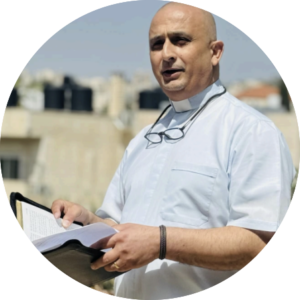
The Presbyterian Church in the Holy Land
March 21, Saturday | On Earth as It Is in Heaven - Velinda Hopper
Matt 6:10 “Your kingdom come, your will be done, on earth as it is in heaven.”
“On earth as it is in heaven” has been heavy on my heart over this last year. It has been my prayer, my hope, and my challenge. Most Christians know the phrase so well we often overlook the magnitude of what it would truly mean for the kingdom of God to be central on earth just as it is in heaven.
There is a magnitude to it that is sometimes too great to even begin to understand, let alone try to accomplish. Jesus teaching his disciples to pray what can only be described as an extraordinary prayer, is a call just as impactful and world changing as the Great Commission. It’s a call to change the world. A call to pray for the extraordinary as we expect the extraordinary.
It is too easy for us to forget that we are called to so much more than we know because we have been shaped and equipped by a God that is able to do more than we can imagine. Every individual call is moved by the undercurrent of God being glorified and His will being done on earth as in heaven.
We have the immense honor of being called to a small piece of that.
You are called into the grace of our Lord Jesus.
You are called to experience the love of God the Father.
You are called to rejoice in the fellowship of the Holy Spirit.
You are called to live the extraordinary on earth as it is in heaven.
“For this reason I bow my knees before the Father…that according to the riches of his glory he may grant you to be strengthened with power through his Spirit in your inner being, so that Christ may dwell in your hearts through faith – that you, being rooted and grounded in love, may have strength to comprehend with all the saints what is the breadth and length and height and depth, and to know the love of Christ that surpasses knowledge, that you may be filled with all the fullness of God. Now to him who is able to do far more abundantly than all that we ask or think, according to the power at work within us, to him be glory in the church and in Christ Jesus throughout all generations, forever and ever. Amen.” (Eph 3:14-21)
ABOUT THE AUTHOR – Velinda Hopper

Velinda Hopper and her husband Kurt pastor Ripley First Presbyterian in Southern Ohio. Velinda is an artist & tattoo artist, and busy mother to 5 amazing kids, 2 dogs, and 1 turtle. Her and Kurt live to experience the adventure that comes with simply being available to God.
Week 6 – Watching and Waiting
March 23 - 28 | Monday – Saturday
DO NOT EDIT
Your content goes here. Edit or remove this text inline or in the module Content settings. You can also style every aspect of this content in the module Design settings and even apply custom CSS to this text in the module Advanced settings.
March 23, Monday | Glorify God and Enjoy Him Forever - MJ Romano
I teach philosophy at the local junior college where we have a sizable population of international students. Every now and then, I get a student whose knowledge of the English language is like my knowledge of auto mechanics: minimal at best. They know how to say hello, like I know where to put my key in the ignition. They know what “test” means, like I know what it means when the light comes on next to my gas gauge. Beyond that? We’re both lost. Finally, they type out what they’re trying to say into Google Translate, hand me their phone, and even then sometimes I’m still lost. I don’t know what they want from me. I worry sometimes that I have the same relationship with Jesus. What is Jesus trying to say to me?
When Jesus showed up on the shores of the Sea of Galilee, he beckoned Simon and Andrew, “And Jesus said to them, “Follow me, and I will make you fishers of people.” (Mark 1:17). If only we got such clear instructions from Jesus. If only a holy to-do list would flutter out of the sky on the day of our baptisms instructing us what job to take, where to live, who to love, who not to love. Yes, sometimes, we will get clear indications. Every other job falls through except the one that moves us closer to home. Every other person turns down our date except the one who turns out to be The One. The church down the road is where we feel like the worship is aimed straight at our gut. Sometimes that happens, but rarely.
Most of the time, we have two or three or four good options, or no options at all. And we’re left to wonder, “What does Jesus want from me?” It’s not often that being Presbyterian comes in handy, certainly not when we’re trying to spell it over the phone to an insurance agent, but this is one of those times. On any ordinary day, when we’re wondering how to follow Jesus and what He wants of us, the first question of the Shorter Catechism of the Westminster Confession of Faith lends a hand. Remember it? Q. 1. What is the chief end of man? A. Man’s chief end is to glorify God, and to enjoy him for ever. I know, I know. We Presbyterians can overanalyze just about anything, but maybe this question’s answer is a simple one. Among all the options with which God presents us, just choose one. Whatever it is, give glory to God and enjoy Him in it. That’s all.
Prayer: Dear Jesus, You call me to follow You. Give me courage with every step, confidence in every decision, and hope in my future with You. In Your name, Amen.
ABOUT THE AUTHOR – MJ Romano

Rev. Dr. MJ Romano is Head Pastor at First Church of La Junta, Colorado, and previously served in Youth & Young Adult Ministries in St. Louis. She holds a DMin from McCormick Theological Seminary, teaches Philosophy and Ethics at Otero College, and serves as ECO’s Director of Mentored Ministry. She and her husband, Chris Ludwig, have two adult children.
March 24, Tuesday | Strength to Say No - MJ Romano
Last summer, a dietitian recommended that I start on an anti-inflammatory diet. It prescribed blueberries, salmon, nuts, even honey. It was a diet I could get behind, until the bottom of the page stated a goal of eating less than 20 grams or less a day. I tried it, and I’m here to tell you, it’s hard. The worst part of it? It worked! When I did stick to it, I actually felt better. I had more energy. My joints didn’t hurt as much, and I even lost weight. You’d think I’d want to stay on it, right? But do I? No. Last week was Valentine’s Day. My dear husband bought me candy, as requested, and I really meant to go easy on it, but the temptation was too much. The temptation to eat sugar is one thing. Temptation to sin is another, with consequences far greater than achy knees.
What’s the apostle Paul’s great line, “For I do not do the good I want to do, but the evil I do not want to do—this I keep on doing” (Romans 7:19)? Consider Jesus in his time of temptation. The tempter whispered to Jesus to exploit his power for no good reason by turning stone to bread, to turn his spiritual power to political power in exchange for worshiping a false god, and to prove himself and his immortality by testing God (Matthew 4:1-11).
These were real temptations, unique to Jesus and who he was. Each time, Jesus answered, and each time Jesus said no.
Our temptations are no less real and no less unique to who we are. Be they the urge to drink too much, eat too much, spend too much, talk too much, or control too much. Be they the fears that keep us from doing what needs to be done or the angers that keep us apart. Whatever they are and however the tempter whispers to us, we can and must answer, as Jesus did. We must say no. And, yes, it’s hard. The call to obedience often is. There may be times when, by ourselves, we don’t have this power to say no.
We are human, after all, and, if not totally depraved, at least weak and fragile. Fortunately, the lesson of Jesus’ temptation in the wilderness tells us something else: we are not alone. Jesus is the Christ, Emmanuel; He is “God with us.” God is with us. With such power as this, “no” might not be within our reach, but it is within His.
Prayer: Dear Jesus, You know what it means to be tempted. You understand my struggle. So give me Your strength to say no, to forgive myself when I fail, and the courage to persevere. In Your name, Amen.
ABOUT THE AUTHOR – MJ Romano
Rev. Dr. MJ Romano is Head Pastor at First Church of La Junta, Colorado, and previously served in Youth & Young Adult Ministries in St. Louis. She holds a DMin from McCormick Theological Seminary, teaches Philosophy and Ethics at Otero College, and serves as ECO’s Director of Mentored Ministry. She and her husband, Chris Ludwig, have two adult children.
March 25, Wednesday | Great Commission, Great Compassion - Jennifer Haddox
The needs in the world are great, but Jesus’ love for the world is even greater.
Jesus’ call to love extends to the world through the church, as we are called to “love our neighbors as ourselves” (Matthew 22:39) and “make disciples of all nations” (Matthew 28:20). Jesus calls us to live out the Great Commission and to respond with Great Compassion to the needs of the world. As we step out in faith to meet with people in their need and share the Good News, we ourselves grow as disciples.
As you look for ways to lead your church growing as disciples of Jesus Christ during the season of Lent and beyond, consider inviting them to a Great Commission & Great Compassion commitment. So often, we invite people to focus on inward spirituality alone during this season – with invitations to fasting and prayer. This is vital, of course! But Jesus’ primary way of making disciples was to send people out to serve, heal, and proclaim. Discipleship during Lent should involve our people going to serve, heal and proclaim the Kingdom of God!
Great Commission; Great Compassion
I began to be formed by a Great Commission & Great Compassion Lenten discipleship as a child. I can remember gathering up loose change, depositing it into a cardboard fish bank, and carrying the jangling bank of coins to Sunday School each week during Lent. I learned the joy of making a difference in the world at a young age from my parents and Sunday School teachers. I never imagined my pennies could solve the world’s problems, but I knew that in Jesus’ hands they could make a life-transforming difference for someone. Through my giving I grew in awareness of the needs of others. In this weekly commitment, I was being shaped as a disciple of Jesus.
Sometimes children can lead the way in helping us live this out by their simple faith response and willingness to make a difference in the ways that they can. A special mission offering can be a simple tool to help children and adults alike learn to be disciples, giving for the sake of others instead of ourselves.
Congregational Engagement
Here are some suggestions for how you can engage your congregation in missional discipleship during this Lenten Season with a special mission offering.
Collect special gifts for a selected mission partner that your congregation supports. This offering provides ways to help the congregation get to know and understand the people on mission they support.
Set up a banquet table for display where people can leave non-perishable food items or financial gifts for a local food bank.
Distribute M&Ms mini tubes to the children as gifts, and invite them to return it filled with quarters towards a specific mission cause, multiplying the blessing they have received.
While we encourage you to strengthen your own mission relationships through a special offering, our ECO Global Mission partners offer the following important ways you can get involved with your generous gifts. eco-pres.org/mission-partnerships
ABOUT THE AUTHOR – JENNIFER HADDOX

Mike and Jen Haddox began to serve as pastors of First Presbyterian Church in the Fall of 2021. They are a husband and wife team who share the lead pastor role. Based on their unique and complementary gifting, Mike takes the lead in family ministry, preaching, and pastoral care, and Jen takes the lead in directing the staff, session, and ministry teams. They share a deep commitment to equipping the church to grow as disciples who are engaged in mission locally and globally. They love spending time with their two boys and extended family in the region. In their free time, they enjoy movies, cooking and eating good food, and road-trip adventures.
March 26, Thursday | The Church That Breathes - Dana Allin
I have been thinking about our calling as it relates to our Cultivating Flourishing Churches framework. Hopefully you are now familiar with this tool and approach through our webinars, articles, presbytery conversations, and breakout sessions at our National Gathering. This framework has been shaped by over a decade of learning from both the successes and challenges of church transformation. At its core, the framework compares a congregation to a tree, with various parts working together to produce fruit. Every aspect: roots, soil, trunk, branches, and leaves—needs to be healthy for the tree to thrive. You can explore the framework in detail here.
One critical element of this framework, often overlooked in earlier conversations about transformation, is the importance of spiritual practices. These individual and corporate spiritual practices are represented by the leaves of a tree in our model. Leaves are the mechanism by which a tree engages in photosynthesis. This is the way the tree “breathes” to expel toxins and have what is needed to create energy. Without functioning leaves, the tree cannot thrive.
In the same way, spiritual practices are essential for our churches and individual lives. They are how we “breathe” spiritually, expelling what hinders us and taking in what sustains us. Lent is traditionally a season for intentional spiritual practices. Many of us take this time to give something up and replace it with practices that bring us closer to the Lord. It is a season of spiritual respiration: releasing the old and making space for the new.
Engaging in these practices is vital for our growth as individual disciples. But just as a single leaf cannot sustain an entire tree, our flourishing is magnified when we collectively engage in spiritual disciplines as the body of Christ. This corporate engagement allows the “tree” of our church to flourish in even greater ways. So, how might you—individually or collectively—use this Lenten season to embrace these practices? But Lent is not just about giving something up. It’s also about replacing distractions with practices that deepen our connection with God. These might include:
- Reflection: Setting aside intentional time to listen to the Lord.
- Engagement with Scripture: Reading and meditating on God’s Word with renewed focus.
- Confession and Repentance: Clearing out what hinders our growth.
- Other Disciplines: Incorporating fasting, prayer, or acts of service into your daily rhythm.
As we move through the Lenten season, I am reminded of our shared desire to see another great awakening in our country. But revival begins with the Church. It begins when we, as God’s people, are intentional about these foundational practices. Just as a tree thrives when all its parts are healthy, the Church flourishes when we lean into the disciplines that allow the Spirit to work in and through us.
May this Lenten season be a time of spiritual respiration for you and your congregation, expelling the old and taking in the life-giving breath of God.
ABOUT THE AUTHOR – DANA ALLIN
Rev. Dr. Dana Allin is ECO’s Synod Executive. Dana formerly served as the President of the board of ECO, the pastor of Indian River Presbyterian Church in Fort Pierce, FL and the pastor of Christ Presbyterian Church in Lakewood, CA. Dana attended Fuller Seminary, where he received both an MDiv and a DMin. He also has a BS in Microbiology from University of California, Santa Barbara and is an Associate Certified Coach with the International Coach Federation. Dana’s passion to encourage and inspire leaders has led him to develop both the Missional Leader Training program and the Coach Certification Process. He lives in Santa Barbara with his wife, Beth and their three children – Micah, Peyton, and Piper.
March 27, Friday | The Calling and Promise of God - Ozzie Menezes
Questions about God’s calling for my life always come for all true Christians, because deep in our soul and spirit there is a desire to please God, fulfill His purpose, and also respond to the salvation that was extended to us one day.
The Bible shows us many examples of people who were called by God: Abraham (Genesis 12:1-4) called to be the father of a great nation, Moses (Exodus 3:1-12) called to liberate the Hebrew people from slavery, Isaiah (Isaiah 6:8) called to be a prophet of God, Peter and other Apostles (Matthew 4:19) called to be disciples of Jesus and leaders of the Christian church. Based on all these examples and many others, God’s calling is not a simple invitation, but a direction that brings meaning and purpose to the life of every Christian.
There are many things involved in God’s calling: knowing the Scriptures, the work of the Holy Spirit, spiritual gifts and abilities, circumstances and needs around us, our profession, guidance from church leaders or brothers and sisters in faith, but I would like to highlight trust and obedience to God even in the face of uncertainty.
Something that is always present in God’s calling is uncertainty. Uncertainty will always lead us to the place God desires, at His feet, trusting and obeying only Him. Therefore, if you are facing a situation of uncertainty and you have an inclination to accept it, even knowing that humanly and rationally it would be an improbable choice, perhaps you are facing God’s calling for your life.
In the Gospel of Matthew 19:27-30, Peter says something incredible: “We have left everything to follow you,” and even more incredible is Jesus’ response to Peter: “Truly I tell you, when the Son of Man sits on his glorious throne, in the renewal of all things, you who have followed me will also sit on twelve thrones, judging the twelve tribes of Israel. And everyone who has left houses or brothers or sisters or father or mother or wife or children or fields for my sake will receive a hundred times as much and will inherit eternal life. But many who are first will be last, and the last first.”
There is a decision to be made, a calling to be answered, and something to be left behind for the love of Christ and His calling for your life. Are you willing to answer that calling and live under the promise of Christ Jesus?
Prayer: Lord Jesus, confirm your calling for my life, give me clarity about where and how you want to use me, may your will be done in my life. I leave behind everything that prevents me from living your calling and I respond to your voice today. In Jesus’ name, amen.
ABOUT THE AUTHOR – OZZIE MENEZES

“Ozzie” Osnir Menezes, pastor, 38 years old, married to Luma Menezes, no children yet. ECO Church Planter of One Way Church in Austin-Texas, Degrees: Theology and Business Administration, Master in Leadership and Theology, Specialty courses: Church Planting and Missions.
March 28, Saturday | When the Spirit Changes the Plan - Jennifer Holz
Acts 16: 6-10; Philippians 2:14-16
Acts 16 is one of my favorite chapters in Scripture. Here we find the origin story of the church in Philippi. The story is full of surprises from start to finish, and it opens with Paul, Luke, Timothy and Silas experiencing obstacles and impediments in their planned route. They set out to visit and strengthen the churches they have helped launch, but for some reason they are unable to enter the places on their itinerary. The new call of the Holy Spirit comes at night in the form of Paul’s vision of a “man of Macedonia” pleading for help in his city. Paul shares what he has seen with the others, and together they conclude that God has called them to a different plan. Immediately they respond to this new call.
Luke (the writer) indicates here that being in step with the Holy Spirit is about paying attention together to the movement of the Spirit within us and around us. To be clear, there is hostility in the story toward Paul and his team along with a brief stay in prison. So, it’s not that following Jesus is pain-free. But the step-by-step obedience of this group produces the fruit of a new church in Philippi and joy in the believers. In reading Paul’s letter to this church about a decade later, we see the Philippian church shining “like stars in the sky” (Philippians 2:15).
Recently, my husband and I stepped out of the general “life itinerary” we had put together for our family. Our new call as a family began in prayer with a sense from the Spirit that we were to “be open.” I like to think that we have always cultivated a spirit of openness and listening to the Spirit. But looking back, we are amazed at how the Spirit gently led us from where we were then (Colorado Springs, Colorado) to where we now are (Carmel, California). Eventually, we experienced our own “man from Macedonia” relaying a need that we were unaware of in a place that was not on our road map. We committed to turning our hearts in this new direction and determined together (and with our close circle of friends and family) that if the doors kept opening, we would keep walking through them.
Our new call came after 24 years of ministry in the same city. We were embedded deeply in relationships, family friendships and our ministry work. But the Spirit of Jesus closes and opens doors for us as if the doors belong to Jesus himself. By God’s grace we strive to work out the work of God in our lives day by day with joy and surrender. And we are grateful. What does this day hold for you and how is Jesus leading you today?
Prayer: Spirit of Jesus, anchor my heart in You today that I might listen and respond to Your voice in the small decisions of this day and in the larger movements of this season where I am living. Give me ears to hear and eyes to see the way of Jesus unfolding before me. With grace and openness, I pray in Jesus’ name. Amen.
ABOUT THE AUTHOR – Jennifer Holz

Jennifer Holz is the Senior Pastor at Carmel Presbyterian Church in Carmel, CA. Her family recently relocated to Carmel after more than two decades of ministry at First Presbyterian Church, Colorado Springs. Her husband Adam is a free-lance writer and media specialist and they have two daughters and a son studying music at Grand Canyon University.
Week 7 – Holy Week
March 30 - April 4 | Monday - Saturday
DO NOT EDIT
Your content goes here. Edit or remove this text inline or in the module Content settings. You can also style every aspect of this content in the module Design settings and even apply custom CSS to this text in the module Advanced settings.
March 30, Monday | A Better Story - Luke Parker
Ruth 1; 4:13–22; Matt 1:6–17
The book of Ruth begins a lot like the book of Job. There is political instability, people following their own truth, and the chaos that results. Then a famine, people and animals starving, not enough to go around. A man named Elimelek (“my God is the King”) and Naomi (“Sweetheart”) take their two boys and leave the country. They become refugees in Moab, a place of God’s enemies. Then Elimelek dies.
Naomi manages to raise her two boys in a world where you need a man to survive, to make money, to own land. The boys get married but after ten years there are no grandchildren. Then the boys die (1:5). So Naomi, destitute, refugee, widow, having outlived her sons, staggers back to Jerusalem weeping. Her daughters-in-law follow her. She tells them, “Go back! I’m not worth it.” They refuse, she insists. One goes home, but Ruth says, “No. Where you go I go, your people my people, your God my God, and where you die I’ll be buried.” This isn’t just loyalty; it’s Ruth stepping into a calling— choosing a life aligned with Naomi’s God and Naomi’s people.
When Naomi gets back to Israel, people say, “Is this Naomi?” She says, “No. Don’t call me Sweet (Naomi) anymore, call me Bitter (Mara), because my story is bitter and the Lord has been bitter, cruel with me. I went away full, and he brought me back empty” (1:19–21). In her grief, she assumes her life is over — that God has nothing left for her. This is the posture Lent offers us: lamenting the bitter side of our story and waiting for the Lord to give us beauty for ashes.
We are prepared now for a harsh tale of survival against all odds: two women, refugees, struggling in a man’s world against a cruel God. But beneath the Iron Age rom-com that follows is something deeper: God quietly at work, calling people into a life better than they would have chosen for themselves. In this season we learn to look for the L:ord’s hand in precisely these hidden places—where nothing looks triumphant, where the tomb is not yet empty.
Throughout the book, Naomi has the experience of glimpsing God behind the scenes and realizing that while initially she thought her story was a tragic one, she is actually living in someone else’s story. At the end of Ruth 4, Naomi has a full-circle moment. She is holding a baby in her arms, a wedding has happened, there is food and a home in which to live. The women from chapter 1 say, “Blessed be the Lord, may everyone know his name! He hasn’t abandoned you. He will be the restorer of your life!” The word for “restorer” (4:15) is the same word in Hebrew that Naomi used earlier (1:21) to describe how her bitterness at God brought her back empty. There is ambiguity in these verses. Who is the “he” that redeems, restores, and provides? Is it the Lord or the baby?
What looked like a dead end was actually the doorway back into Naomi’s true calling—woven into God’s plan in a way no one could have anticipated.
The genealogy at the end of the book is where we learn that this has not been the story of Naomi’s hardship, or of Ruth and Boaz coming together, or even the story of Obed. It’s been a different story that the Lord has been writing all along. This is the story of God calling his people out of death and into life in Christ! What initially looks like chaos and tragedy ends up showcasing God’s faithfulness, his love for his people. Even when the script seems stalled, even when all we can see is loss, he is writing a better story (Rom 8:28).
Matthew picks up where Ruth’s genealogy ends to tell us that the story is even better than Naomi or Ruth could have imagined. This has actually been the story of Jesus all along, the true king of Israel is headed to the throne! God has a better story for Naomi, for Israel, and for you than we could ever have asked for or imagined! The Resurrection will declare what Naomi’s story already whispers: Christ is with us when we suffer and death does not have the final word!
ABOUT THE AUTHOR – Luke Parker

Rev. Luke Parker is ECO’s Church Planting Director. Luke formerly served as a Church Planter/Pastor in an ECO plant in Phoenix, the student ministries director at a non-denominational church in AZ, and in several other church plants in a variety of roles over the years. Before ministry in the local church he was heavily involved in Young Life. Luke attended Fuller Seminary, where he received an MDiv. He also has a BS in Biochemistry from the University of Arizona (Bear Down). Luke’s passion to raise up young leaders and equip them to reach the lost in our time. He lives in Phoenix with his wife, Jessica and their two boys – Matthew and Samuel.
March 31, Tuesday | The Courage to Look - Laura Crosby
The other day a friend of mine tripped and fell hard at the pool, sustaining a deep, long, very bloody gash all the way up her shin (among other less gory injuries). A group of us gathered around to help while her husband went to get the car to take her to the ER, but it was very difficult to look at. We just didn’t want to face the wound. It was painful to look at.
Lent is the part of the story that is ugly and messy and requires humility and self-examination and I’d really rather avoid both thank you very much. I like to think I’m a “pretty good” person.
I have “acceptable sins” that I unconsciously sort of think God can overlook instead of actually having to die for. Come to think of it, I prefer “occasional weaknesses” to “sin”. The problem is that sin is sin is sin and any sin separates us from God. When I get sucked into thinking there’s anything “acceptable” about my sin, I’m living out of a works mentality instead of acknowledging my complete dependence on God’s grace. I pray, “Open my eyes to my blind spots.” but it’s a half-hearted prayer if I’m honest. I’d much rather close my eyes, stick my fingers in my ears and loudly sing “LALALALA” to drown out the truth. But lately I can’t escape it.
I keep being brought smack up against my true sinfulness. I’m in situations where I’m horrified with my impatience, and sharp words, and critical spirit and selfishness, and pride and intolerance… I think, “Holy buckets, I really DO need a savior!” “Duh”, you say. But here’s the uncomfortable truth. “The heart is deceitful above all things.” Jeremiah 18:9 and all of us (yes, even you) are prone to rationalizing.
The reason Lent is so long is that the path to the truth of oneself is long and snagged with thorns – Edna Hong
I don’t like Lent because it’s all about sin that when exposed is like my friend’s terrible leg gash, and I want to avert my eyes and pretend such ugliness doesn’t exist, at least not in me.
The good news is, “There is now no condemnation for those who are in Christ Jesus.” (Romans 8:1) That’s the Easter part I’d like to skip to!
But I can’t live Easter until I truly experience Lent. There can’t be forgiveness without repentance. There can’t be resurrection without death.
Prayer: Lord, give me the courage to face the sin I’d rather rationalize or ignore, knowing that the many things I do, words I say, thoughts I think…all the things that separate me from you are forgiven because Jesus died for me. You wrap me in the arms of your infinite love and I am grateful. Amen
ABOUT THE AUTHOR – Laura Crosby
Laura Crosby is an enthusiastic follower of Jesus, who loves to help people connect to God and each other by creating a welcoming space around her dinner table, walking alongside young leaders, traveling to encourage Christians around the world, and telling stories of God’s faithfulness through speaking and writing. She got her Masters of Theology while her kids were in high school and has partnered with her husband in pastoral ministry for 43 years.
April 1, Wednesday | Obedience Without Immediate Reward - Lauren Warman
Hebrews Chapter 11, emphasis on v. 13: All these people were still living by faith when they died. They did not receive the things promised; they only saw them and welcomed them from a distance, admitting they were foreigners and strangers on earth.
The 21st century has produced incredible advancements in research, technology, and connection, but we have also been presented with the double-edged sword of instant gratification. The immediate “reward” or sense of accomplishment that we get when we click “Buy Now.” Or, conversely, the frustration we feel when our Keurig pods are not eligible for two-day shipping. Or maybe you’ve heard the phrase westernized by many from eastern world religions as “instant karma.” Like when someone is rude to their Starbucks barista and then on their way to their car, they drop their full iced latte on the ground, and you feel that justice has been served (you can admit it!).
Phrases like instant gratification and instant karma have been giving me pause lately. When I make the time, these phrases make me think about the way that the world works, and the way that our God works. We see throughout the Bible that God is not often in the business of instant gratification, and the Hall of Faith in Hebrews chapter 11 is a great place to be reminded of this. We see what actions were taken (or not taken) by the faith of these Old Testament believers.
I want to focus on verse 13, where we are reminded that “All these people were still living by faith when they died. They did not receive the things promised; they only saw them and welcomed them from a distance… (v. 13).” I cannot think of anything further from instant gratification than what we read here. These heroes of the faith accepted the possibility, likelihood, or promise, depending on their story, that they would not receive the reward for their often costly obedience to God during their earthly lives. To us, if we’re honest, does that feel fair? Does that feel like an outcome worth the sacrifices or effort we make to obey the Lord?
The Lord always calls us to obedience. Often that obedience is costly. Sometimes that obedience will not bear the fruit we expect in our lifetime. Almost always, that obedience will not result in a neatly packaged reward delivered to your front step in two business days. But holy obedience is eternity-minded obedience. It’s obedience that is willing to accept earthly incompletion. It’s obedience that is not validated by visible, immediate outcomes, but by faithful perseverance. It’s obedience that honors God and brings us into deeper dependence on and relationship with him.
Prayer: Lord, teach me to find joy in the waiting; in the anticipation of your promises fulfilled, maybe not in my lifetime, but on your timeline. Help me to embrace the call to obedience and strengthen in me the trust it takes to follow where you are leading. Shape my heart, mind, and soul to see holy obedience as a joy, not a burden. In the mighty name of Jesus, Amen.
ABOUT THE AUTHOR – Lauren Warman

Lauren Warman is the Leadership Formation Administrator for ECO. She is married to Phil and together they share 1-year-old daughter Mallory (who is more occupied by camera lenses than smiling for photos!) and dog Remy. Lauren is a graduate of Taylor University and spent 4 years in vocational ministry in Dallas, TX before working for ECO’s National Office.
April 2, Thursday | The Pleasant Place of Boundaries - Rev. Dr. Laura Baghdassarian Murray
Psalm 16
A few summers ago, I had the opportunity to walk a portion of the Camino de Santiago. Each day we walked anywhere from 10-18 miles. The last day into Santiago, we were told our walk was going to be about 16 miles. That estimate was off – and it actually ended up being about 19 miles.
That day I decided to walk with someone in our group for most of the day (rather than walk in solitude as I had the days before). This was our sixth straight day of walking, and the false summits of thinking we were close to the end were disheartening. I was grateful to be walking and talking with someone rather than walking on my own, but that meant that I didn’t pause and take breaks when I needed them. I wanted to keep going and just get to the end. And I also didn’t want to hold her back or show that I couldn’t keep up, so I kept walking even though the pain in my hips was excruciating. We would stop for stretches, but they were about one minute long. Another person in the group walked up behind and asked me if I was okay because of the way I was walking…she could tell I was clearly in pain. My pride, my ambition, my desire to “just get it done” blew past the limits my body was communicating to me.
Throughout Psalm 16, the Psalmist, David, shares about the boundary lines God has given him. As he shares the gift and joy of them, he also goes back and forth in the Psalm regarding the claims he makes about God and the choices he lives out. Back and forth between claim and choice.
And as we backtrack in the choices David makes in verses 3-5 we see that he:
- Delighted in good people.
- Recognized idols and choice to not serve them
- Chose to receive God’s boundary lines and welcome what God gives.
We all have limitations. These limitations can serve as boundary markers that not only protect and care for us but make way for joy and delight. David is no stranger to public service and obedience. Yet he is also no stranger to the pull and draw and living outside of obedience and the boundary lines God gives us as his followers.
I wonder for you, as you make claims and choices and live a public ministry, what are the boundary lines God has given to you?
Do you welcome these lines within your calling?
And how might welcoming God’s boundaries and limitations be an act of obedience?
Prayer: God we thank you that you are a giver of good gifts. That your boundaries and limitations on us are not to frustrate nor are they futile. That you purpose for us good work to do and you purpose the boundaries of that good work. Help us to see and honor what you have called us to and choose to live knowing your security and love for us. Amen.
ABOUT THE AUTHOR – REV. DR. LAURA BAGHDASSARIAN MURRAY
Laura is the Director of Spiritual Engagement and Innovation at Fuller Seminary’s Center for Spiritual Formation. She is also a spiritual director, retreat leader, writer, and an ECO pastor serving in the Validated Ministry of Spiritual Direction. Laura has spent over 20 years in ministry in spiritual formation, pastoring, writing, and developing leaders. She holds a Doctor of Ministry from Fuller Seminary and a Master’s in Theology. Laura lives with her family in the Dallas area. She believes dessert is only dessert if it involves chocolate.
April 3, Friday | Called to Build Bigger Tables - Kaitlyn Wood
Luke 14:15–24
In seminary, a professor asked our class what it would look like to “end well” in ministry — that is, with our spirit, soul, mind, and community intact. It wasn’t a question about success, it was a question about faithfulness and living with purpose. Not long after, I was at a restaurant and noticed a woman celebrating her 65th birthday with her grown children and husband. They were laughing loudly, leaning across the table, telling stories only they understood. There was no hurry, no performance, just joy and presence.
And I thought: That’s it. If I get to the end of my leadership season still gathered around a table with the people I love, who love me, still sharing life, that will be enough. There is something sacred about a table. Meals slow us down and put us face to face with each other. An invitation into someone’s home is more than an event; it is an opening of your life. It should not surprise us, then, that Jesus spent much of His ministry around tables. He ate with tax collectors and sinners, he accepted invitations from Pharisees, he healed and taught and disrupted expectations between bites of bread.
In Luke 14, Jesus tells a story about a great banquet. The invitations go out and one by one, people decline. The invited guests decline, distracted by land, by work, by ordinary responsibilities. Their excuses are not scandalous, these people are simply busy. So the host sends his servants back out into the streets and lanes to bring in those who would never expect an invitation. And when there is still room, he sends them out again. “Go out to the highways and hedges… that my house may be filled.”
Jesus spent His ministry around tables not just because He loved dinner parties, but because He was announcing a kingdom that looks like a bigger table and a wider invitation.
And Lent reminds us that we are not only recipients of this invitation, we are participants in it. We have been welcomed into a feast we did not earn and now we are called back out with the same invitation to those around us. Because tables do not fill themselves.
Somewhere along the way, many of us have outsourced hospitality to the church building or the church calendar. We attend events rather than extend invitations. We protect our evenings and guard our homes. We assume someone else will widen the table.
The question for us this Lent is not whether God is inviting, He always is. The question is whether we will join Him in extending the invitation to others. Perhaps ending well is not about building impressive ministries, but about the call to faithful obedience in ordinary spaces by making room in our homes and schedules as we hear the call to be people who invite others to the table. Who is God calling you to invite to the table? What would it look like to widen your table this season?
Prayer: Lord Jesus, You welcomed us before we knew how to ask. Give us courage to open our doors, loosen our schedules, and trust that Your kingdom grows one ordinary invitation at a time. Amen.
ABOUT THE AUTHOR – Kaitlyn Wood
Rev. Kaitlyn Wood was born and raised in upstate New York. She earned a BS in Communication Theory at Eastern University and an MA studying Religion, Media, & Culture at RPI (Rensselaer Polytechnic Institute). In 2015 she discerned the call to vocational ministry and entered Northeastern Seminary in Rochester, NY. As a pastor, she worked with her congregation to bring about transformation, a renewed vision, and a heart for the region. Kaitlyn is passionate about equipping pastors and churches for holistic revitalization, which is the focus of her current DMin project at Northeastern. When she isn’t working with churches, you can usually find Kaitlyn at the baseball fields with her husband Matthew and three boys – Levi, Jonah, and Aaron.
April 4, Saturday | Called, Set Apart, Sent - Rev. Saona Jackson
“Paul, a servant of Christ Jesus, called to be an apostle and set apart for the gospel of God.” Romans 1:1
When I have doubted God’s call upon my life, or when I am discerning which direction God is calling me next, I usually overthink and overanalyze everything. To counter my overthinking, I turn to the apostle Paul (who was also a recovering overthinker, I think). I’m especially drawn to Romans 1:1. In today’s world, this would probably be Paul’s Instagram bio or LinkedIn headline, right? Paul is so simple, so clear, so bold about his identity, his calling, and his purpose. If only our callings were that clear, that easy to articulate!
Perhaps I turn to Paul’s greeting with the hope that the same God that called Paul to be an apostle, has called you and me into simple, obedient, specific service. Perhaps Paul can teach us something about discerning our call. Perhaps we don’t have to overthink or overanalyze our calling, but rather boldly and obediently live it out.
Paul is not casting a grand vision of his abilities or leadership. He is a servant under the authority of King Jesus. It is enough for us to stop here. What if today in this Lent journey we are on, or in our doubt or discernment of calling, we simply live into this identity: I am a servant of Christ Jesus. Then it is Jesus’ voice we are listening to, it is his command we follow, and it is by his authority that we step into our calling. For me, when I want a “big and awesome” calling, but struggle to do dishes and laundry, respond to emails joyfully, and be content with my life, this identity grounds me.
Paul is not giving us a resume, listing his credentials, or identifying his many gifts. He has a specific calling: apostle. He is separated for one thing: the gospel of God. It doesn’t always seem as easy for us to discern or declare our calling. However, Paul’s specificity and clarity can help guide us into a place of simple obedience and confidence in the One who calls us and sets us apart. What if Romans 1:1 becomes a guide for your calling, identity and life purpose? Lent is a time to do some deep work with God, but don’t overthink it: You are a servant of Christ Jesus, called to be a _______ (you can fill that blank in with God), set apart for the gospel of God.
A Prayer for Those Doubting or Discerning:
God, settle my scattered, proud thoughts in your presence. Help me to remember your grace and goodness. Help me to remember the joy of my salvation. Help me to remember your sacrifice and forgiveness. I rejoice and I give you my life in return, Lord. I am your servant, wholly yours. As my thoughts settle, I want to hear your voice, only yours. I remember that you have put a clear call upon my life, you have set me apart for your gospel. Thank you, Lord.
ABOUT THE AUTHOR – Rev. Saona Jackson

Saona Jackson is the Co-Director of Ordination in ECO. She was born in Hawaii and grew up in Southeastern Connecticut. She has a BA in Religion and Leadership Studies from the University of Richmond and an MDiv from Harvard Divinity School. She has served in churches and ministries across six states (VA, MO, TX, MA, OR, CA). Before joining ECO staff, Saona most recently served as Pastor of Discipleship at Malibu Pacific Church in Malibu, California. She currently lives in Agoura Hills, California with her husband, Drew, and their four children Scarlet, Naomi, and Thomas and Phoebe.